Monday, March 22, 2010

Pooey Looey

Warning: Ya’ll are going to think ds.mama is a bit nuts after this post. But I swear to you as crazy as it seems, it works. And successfully getting my 18 month old with Down syndrome ready to potty train is worth all your laughter and scorn :-)

Ah... potty training, a daunting task to accomplish with any child... Some people see potty training as an event, something you settle down and do one week. Not me... in our house potty training is a process that begins with elimination awareness and eventually ends two years or so later with saying bye bye to pull ups at bedtime.

During our last IFSP meeting, I mentioned that one of my goals over the next six months was to begin pre-potty training... Six shocked faces stared silently at me. Summer was 16 months old and her team was probably trying to figure out how to break it to me that she was nowhere near ready to start potty training.

Little did they know, I have been “pre-potty training” Summer since she was about six months old. I had learned some interesting things about potty training with my first few kids and I decided as each one came along to add to the “pre-potty training” repertoire all that I was noticing. I also had a friend who bravely did the EC method with her only child, and had relative success with it. I thought to myself, why not take the best of all this and see what happens.

Pre-potty training tricks
The very first step you can take, at any early age you choose, is to help your child connect elimination with a special sound. Notice how your infant child acts when he is poopin. There is likely going to be some grunting, wriggling, and a red face. Take the time to identify to your child what is happening. I sing a goofy made-up song to a warped version of the Sanford and Son theme song.... It goes something like, “A poo poo pooey, a pooey looey, a poo poo poo poo poo poo poo, a pooey looey...” Ahem, you get the idea (and yes, I do refrain in public).

If I have missed the event, I sing it when I am changing her diaper. The only time she hears this goofy song is when she is going or has gone poo. Over time, she has made the connection.

The next step is to help your baby associate going potty with a potty-chair in the bathroom. You can begin this step once your baby can sit on a chair or low bench on her own and can understand cause and effect and sequence. (An example of understanding sequence is that your child knows his routine and expects certain things to happen next. I usually start this step around 16-18 months old.)
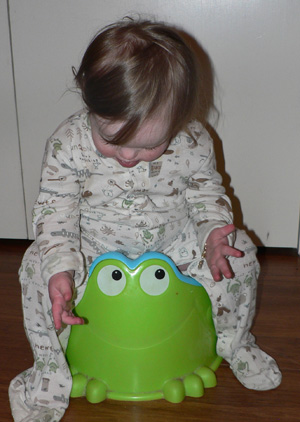
pottyFind a sturdy, comfy potty chair to keep in your bathroom. Make the sign for bathroom and then put her on the potty (clothes, diaper, and all) when she shows that she is getting busy. Sing the goofy poop song, and imitate her grunting. Yup, you read that right. Do some face to face grunting and then tell her it is her turn. She will imitate you back and you will be happily surprised at the results.

I do not start off doing this every day or for every elimination. When we have the time, and she seems very alert and is in a good mood, I will take her into the potty and let her practice. Sometimes if I am sure she hasn’t already started going, I will let her sit diaperless and actually go in the potty.

My pre-potty training goal is to teach her body to expect to go on the potty when she needs to poo. I have given her elimination awareness, a sign to use, and practice in the position. Next year, when she is ready to start actual potty training, she’ll already have these basics ingrained.

Your Turn
Ok moms who have been there, done that... do tell. How and when did you start potty training, and what worked best for your child?

From Theory to Practice :-)

Tausha: No Way!!! That did not just happen!!

Saturday, March 20, 2010

Oh Kelvin, Guess What?

Your mom (Madi) and dad (Brady) entered the Winter Giveaway and won! So you are getting some goodies in the mail, just as soon as one of your parents emails me to tell me where to send them.

winterwinner

Monday, March 15, 2010

Supplements—DHA & EPA

What is it?
Docosahexaenoic acid (DHA) is an omega-3 essential fatty acid derived from fish oil. Eicosapentaenoic acid (EPA) is another omega-3 fatty acid and it is often found in products that contain DHA.

Why would I want to give it to my child?
DHA is required in high levels by the brain and retina as an essential nutrient to provide for optimal neuronal functioning (learning ability, mental development) and visual acuity.

Studies have been done on children with autism and with other developmental differences, and the results showed that after 3 months of taking DHA & EPA, there was a 6 month improvement in reading and spelling levels, as well as significant behavioral improvements.

When I asked our developmental pediatrician about omega-3 oil, he said that there is proof that it has positive impact on brain development in infants and children. I had already been using it for a while but this was reassuring to hear.

Where can I get it?
Moms can start introducing omega-3 during pregnancy by taking fish oil supplements. Then later your baby can continue to receive DHA & EPA through your breast milk. Some formulas are enhanced with DHA, (but as far as I know, only Baby’s Only by Nature’s One derives the DHA from eggs. More on this topic under side effects.) Omega-3s can also be found in enhanced milk as well as in enhanced eggs (I wonder what those chickies eat).

Children's DHAThe easiest way to get it, and one of the safest, is through Nordic Naturals Children's DHA which has the highest omega-3 level of any cod liver oil. Nordic Naturals products have consistently high standards and test under the maximum allowances for toxins and heavy metals.
There is also a plant derived omega-3 fatty acid, a-linolenic acid (ALA), but the metabolic conversion of ALA to DHA/EPA (combined) by metabolism is very limited in humans and certain forms of ALA have risks associated with taking them.

What are the side effects and risks?
One of the positive side affects of taking omega-3 oil is that it helps to keep your baby from becoming constipated. Like some other oils, it helps to keep things moving along.

The Nordic Naturals website lists possible repeating (or spitting up) as a side effect. It says if this happens it could be because, “your body may not be manufacturing enough lipase, the digestive enzyme our bodies make to digest fats and oils. If you haven't ingested fish oils for a long time, it might take a week or so for your body to adjust and make more of this enzyme.”

Aside from that, I have found no other negative feedback associated with the Nordic Naturals omega-3 fatty acids, DHA & EPA.

Mercury and other toxins are a risk associated with some brands of omega-3 oils so do brand research before you purchase an omega-3 supplement.

Several sites mention dangers in the processing of ALA oils, Mortierella alpina oil and Crypthecodinium cohnii oil (sometimes listed as M. alpina oil and C. cohnii oil). These oils are extracted from fermented fungus and algae with a neurotoxic chemical solvent. The C. cohnii oil (algae) & M. alpina oil (fungus) used in many infant formulas are treated with hexane solvent, acid, and bleach. Some infants have experienced serious adverse reactions to these additives. Hmm, I wonder why.

Based on my research I did when choosing a formula and supplements, I found that Baby’s Only formula and Nordic Naturals omega-3 oil were the safest ways to get DHA & EPA into my babies. All of my children are still taking one or both of these products.

Your Turn
Is your child taking some form of DHA supplement? If so, what are you using and what results are you seeing if any?

Sources
DHA/EPA Omega-3 Institute
Omega-3 Fish Oil Blog
Nordic Naturals
The Cornucopia Institute

Monday, March 8, 2010

EI—Who, What, When, and Why

The purpose of Early Intervention (EI) is to teach us how to give our little ones the extra support they may need to develop effective motor planning and skills.

pt1

EI starts off with the assignment of an EI service coordinator and an initial evaluation to figure out what therapeutical services will be beneficial for your child. During the evaluation you will be asked what things are important to you and your family concerning your child. Based on this evaluation and your input, a team of therapists is pulled together to help you and your child reach the goals you have set out.

The goals are written up for a six month period in a document called an Individualized Family Service Plan (IFSP). The IFSP is a living document that gets updated every six months (and sometimes sooner depending on any special circumstances) to reflect your families on-going needs and goals.

pt2

It is important to know three things about EI therapists... first of all, they work for you and your child, and you get to decide if the relationship is working out. If you are uncomfortable with a therapist for any reason at all, you can ask your EI service coordinator to switch the provider. Second, not all EI therapists have experience working with children with Down syndrome. And third, there are several concentrations within specific therapy fields. For example, some occupational therapists may have a strong background in sensory, while others may have more experience with self-care skills such as feeding and dressing.

When you are determining who will be working with your child, you should make sure the provider has experience with children with Down syndrome, and a level of expertise in the areas that are specific to your goals. In other words, not any old therapist will do.

pt3

Almost all infants with Down syndrome can benefit from working with a physical therapist (PT) and a speech and language pathologist (SLP) with a background in newborn feeding and oral motor skill development. Some infants may benefit from spending time with an occupational therapist (OT) who can provide a sensory program that includes deep pressure and brushing. Between 8 to 10 months of age, you probably should start pushing for a special instruction teacher. This educator will use play therapy to begin teaching your baby sign language, concepts such as in/out and up/down, as well as choice-making and other cognitive skills.

When EI is working right, you will find that you have a team of encouraging therapists who are:
—showing you at a detailed level all of the amazing developments your baby is achieving.
—training your child’s neurological pathways in effective motor activity and motor planning.
—teaching you how you can incorporate basic skill development into your baby’s everyday routines.
—teaching you how to provide your child with motor training, and sensory and cognitive experiences and that will help him develop constructive life skills.

pt4

EI is not about pushing your baby to the next big milestone, it is not about comparing your child to others, and it is not about making you feel inadequate as a parent. If you are experiencing those things, it may be time to consider some changes to your child’s team.

Your Turn
When did you start EI and what services did you start off with? What have been the pros and cons of EI for your family?

Thursday, February 25, 2010

A Bevy of Boy Beauties

Remember William from last month’s birth announcements? Well, his mom Tracy was kind enough to send us a picture of him. Isn’t he adorable?

williampic

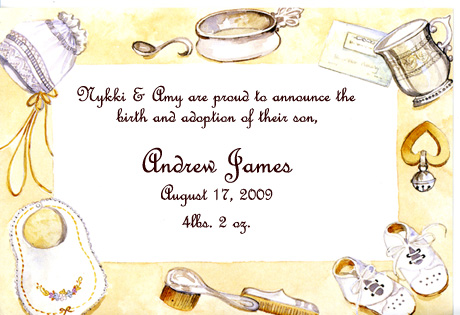
Andrew
Nykki and Amy have been blessed with a son, Andrew. Check out Nykki’s blog, Past The Apple Orchard to see lots of pictures of little “Roo”.

AndrewJames


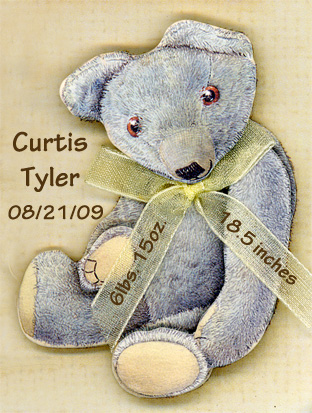
Curtis
With great joy, Josh and Berit announce the birth of their son, Curtis. BabyBee can be found hanging out and looking darling on the Beary Bee blog.

curtis


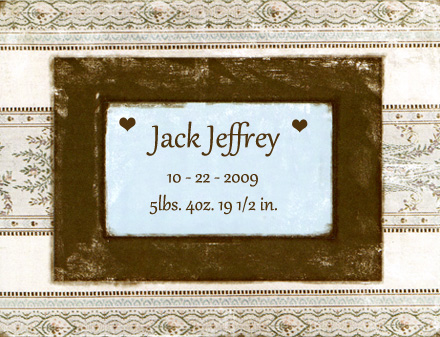
Jack
Angi and John are delighted to introduce their first child, Jack. He is the star of the show over at Life in Color.

jacjjeffrey


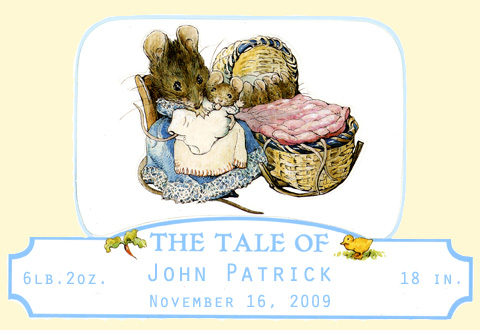
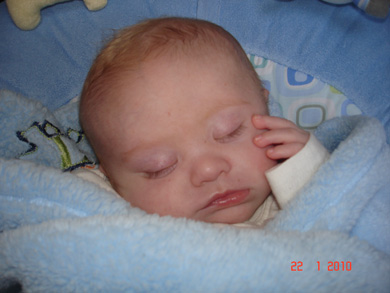
John
Meg and Dan welcome a beautiful new son, John. He joins brother Danny and sisters Maggie and Emily. He's not on the Web yet, but mom sent a picture so that we can oooh and ahhh over him anyway.

johnpatrick

johnpatrick1


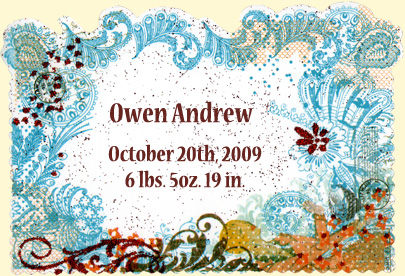
Owen
Andy and Ashley are honored to announce the birth of their first child, Owen. You can let Owen completely charm you at My Little Peanut.

owen


If you would like our community to know about the arrival of a child with Down syndrome, please send an email to ds.mama with the baby's info and an email address or blog/website address of the baby's mom or dad.

Wednesday, February 17, 2010

Stand Up

As a new parent to a baby with Down syndrome you learn fairly quickly that the world isn’t always the kindest place to raise kids. There are lots of things out there that hurt our feelings, and our children’s sense of worth.

This brings out the mama and papa bears in us and we become advocates and educators. We want the whole world to see our precious children through our loving eyes. That is why so many of us blog and make use of other social media.

And right now we are big news. We are working hard to eradicate painful insults by letting people know that it hurts and that it is unacceptable, and immature. The culture around us is rumbling with fallout from Rahm Emanuel’s highly publicized indiscretion. It is the right time to stand up and be heard.

Please head over to Oz Squad and sign the letter written to educate Sarah Palin on the best way to fight for our children. She has the speaking platform we need and we have the voices she can use.

Monday, February 8, 2010

Oral Motor Myths

Myths... a high-arched narrow palatal vault (that would be the “roof” of the mouth), tongue protrusion, mild to moderate conductive hearing loss, chronic upper respiratory infections, mouth breathing, habitual open mouth posture, and the impression that a child's tongue is too big for his mouth... all myths.

Speech and language pathology expert, Sara Rosenfeld-Johnson published an article back in 1997 titled, The Oral Motor Myths of Down Syndrome. In the article she lists seven structural/functional disorders (the myths above) that she feels can be prevented.

In other words, infants with Down syndrome are not born with these oral motor differences; instead they develop them based on inappropriate therapeutic approaches to feeding difficulties present at birth due to low tone.

Rosenfeld-Johnson writes, “Orally, these children look pretty much like any other infant with the exception that they have a weak suckle. This critical observation draws us to the connection between feeding muscles and muscles of speech. In quick order, a cascade of events unfolds for these babies with weak suckle.”

The events she refers to begin with making it as easy as possible for the newborn to eat which sets in motion a downward spiral of circumstances that lead to the development of the above-named oral motor irregularities.

There is an assumption in the medical community that babies with Down syndrome do not eat well, and that they inevitably demonstrate all or most of the seven structural/functional disorders seen in many people who have Down syndrome. Because successful nutritional intake is one of the primary goals that needs to be reached ASAP with a newborn, nurses and doctors often push solutions that may be in direct conflict with the best oral-motor therapy techniques for improving a baby’s oral motor skills.

I can tell you from experience that this is true. I had a baby with severe heart defects that could not eat enough on her own to survive. She could not successfully nurse, nor would she drink well from a bottle. I did not know about Sara Rosenfeld-Johnson’s theories. If I had known, I would have used them as support for my stubborn ideas about feeding and continuous oral motor stimulation.

So what are SRJ’s recommendations?
1. When a baby is being fed, his mouth must always be lower than his ears.

2. A breastfeeding mom should stimulate the mammary glands while her baby is nursing to increase milk flow. Over time, as the baby’s strength increases, gland stim will no longer be necessary.

3. A bottle-feeding parent should use bottles with disposable liners. This allows the air to be pushed out of the bottle causing a vacuum and making it possible to feed in a position where the bottle nipple is presented from below the mouth. The caregiver can push gently against the liner if necessary to facilitate the flow. Rosenfeld-Johnson explains, “This position encourages a slight chin tuck and the child draws the milk up the nipple predominately with tongue retraction. This position and retractive action prevents milk from flowing freely into the child's mouth. The child no longer needs strong tongue protrusion to enable swallowing. It is also important not to make the hole in the nipple larger.”

The article clearly explains how feeding approaches can alter your baby’s future both positively and negatively, making it a valuable read.

Your Turn
Can following these fairly simple suggestions have a significant effect on your baby’s future oral motor structural and functional formation? My child’s oral motor development has been consistent with what was presented in the article, so based on that (and the fact that the points in the article made sense) I would say give it a try.

What about you? Did you by chance feed from birth according to SRJ’s method? Did you not? Does your child exhibit any of the mythical characteristics, or not?

Monday, February 1, 2010

Heart Scar

One of the most frightening things parents may ever face is surgery on their baby. It is said that approximately 45% of babies with Down syndrome are born with a congenital heart defect. Many of these defects require corrective surgery. Before you read anything else, know that heart surgery today has a 95-99% survival rate. I can’t minimize the fear and risks involved but it is important to know that these are very common surgeries performed by excellent, experienced pediatric heart surgeons.

The most common defect is a hole in the heart between the two upper and/or lower chambers which allows oxygenated blood to mix with blood that is returning into the heart. These types of defects are called AV Canal (endocardial cushion defect), VSD, and the less common ASD.

The hole in the heart types of defects usually lead to open heart surgery when the baby has gained some weight and grown a bit. The timing of surgery is often decided by balancing weight gain versus the slide toward congestive heart failure (CHF). CHF is the medical term for saying that the heart cannot continue to do its job without the support of medication (lasix, digoxin, etc.) and perhaps oxygen.

While I am talking about such scary stuff, I will also mention there are more rare heart defects that require surgery before a baby can leave the NICU. A coarctation of the aorta is one such defect.

A baby with a congenital heart defect will be followed by a pediatric cardiologist. She will get echocardiograms (a fancy heart ultrasound) and heart x-rays. She might also get an ECG (the test where they stick the wires on her chest and measure the heart’s electrical activity), or even perhaps a heart MRI. All of this information is shared with a pediatric heart surgeon and he will use it to determine the appropriate surgical fix.

When I first heard (at 30 weeks gestation) that my baby would need heart surgery for an AV Canal defect, I was terrified. The sick-to-my-stomach kind of scared. And I had visions of an angry red zipper scar running from the bottom of her neck to her abdomen. When at three weeks old they told me she had a coarctation of the aorta that required immediate surgery, you could have knocked me over with a single breath.

So yeah, I won’t minimize it. Heart surgery is scary for us parents. The first look at recovery is daunting. There are multiple wires and tubes attached, each serving a unique purpose. But, your baby is feeling no pain and she is being cared for by two or more cardiac nurses specially trained to aid in her recovery. You however may need a stiff drink.

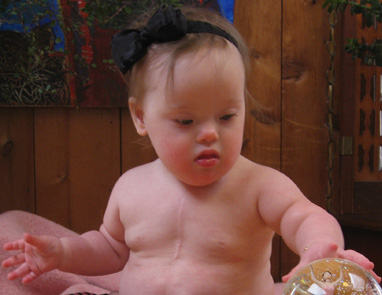
The recovery period for a baby is amazingly quick. In most cases, you will be home within two weeks of surgery. Six weeks later, you will stare at your strong happy baby and wonder if it ever really happened. And there it will be, a thin line a few inches long drawn down her chest, the heart scar. The badge of courage and strength, that if kept out of the sun, will nearly fade away over the next few years.

heartscar

Your Turn
If your baby has a congenital heart defect that requires surgical repair, you may want to take some time to visit the blogs listed under the Sweethearts & Fighters blogroll in the left column. The path is well worn and you may find encouragement and peace as you read through the stories of those who have walked before you.