Showing posts with label developmental stages. Show all posts

Monday, November 19, 2012

Stage Three Toys We Love

Stage three... your baby has mastered some powerful gross motor skills like sitting, crawling or cruising and experimenting with self-feeding. He is now interested in the finer things in the toy box and is often able to use a toy as it was intended as well as in many other creative ways. So let’s go holiday shopping.

(Got a little one in an earlier stage? Check out Stage One Toys and Stage Two Toys.)
magnadoodle
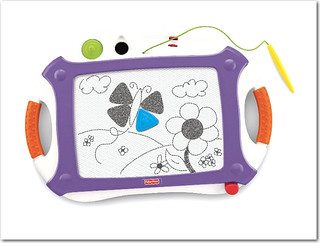
1. Classic Doodler With 2 Stampers - Classic Purple The Magna Doodle is an easy to use, mess free magnetic drawing board with a chubby stylus that is easy to grip. Your baby will enjoy her all important first scribbles and you don’t have to worry about her mouthing the “pen”. $19.95 at Amazon.

Mini Magnadoodle—Fisher-Price Travel Doodler Pro.Same great toy but in a smaller size so you can take it with you to occupy your baby in the car, the waiting room, or on vacation. $9.99 at Amazon.

Magnadoodle Table—Crayola Sit 'N Draw Travel Table.This version of the drawing board has pros and cons. It is in a mini table perfect for little ones who want to sit or kneel, or even stand while they draw. However, the slide eraser is difficult to manage and your child might require assistance from you to make it work. The stylus fits too snugly in its holder and your child will probably not be able to get it out by himself. These drawbacks have earned it bad reviews. About $35 through Amazon but only 24.99 at Bj’s Wholesale Club.

babyboydoll
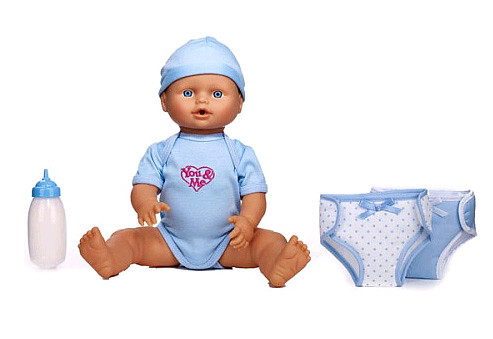
2. Baby Doll. Young children, girls and boys, are very interested in babies. Your little one is beginning pretend play and will enjoy interacting with their own baby to bottle feed and hold. Having a baby doll is a terrific way to introduce your child to new or stressful experiences like potty training or going to the doctor. You can model what will happen and encourage your child to help with the activity. Any baby doll that looks realistic will do. The baby doll pictured here is the You & Me Mommy Change my Diaper Doll - Boys available at Toys R Us for $14.99.

ball
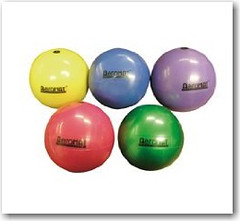
3. AeroMat Weight BallBy now your baby is ready for a weighted ball. Playing with a heavier ball will help her build muscle strength and is a great way to get in some physical therapy while having fun. After all, what better thing is there to toss at a tall tower of blocks but a weighted ball? The 2 lb version is $19.49 at Amazon.

monkey
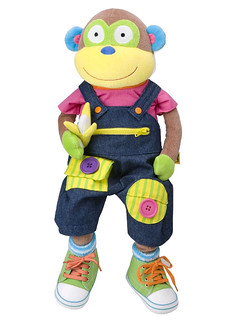
4. Alex Toys Learn to Dress MonkeyBy now your baby is probably cooperating while getting dressed. He is beginning to get interested in how his clothes work and the Learn to Dress Monkey is the perfect practice friend. The monkey’s clothes have different textures and offer opportunities to snap, button, and zip. As your child grows and gains more fine motor skills he can practice lots of other dressing activities as well. $29.59 at Amazon.

tunnel
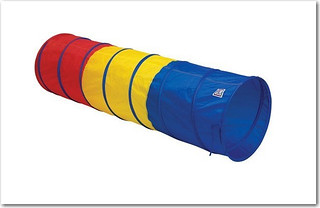
5. Pacific Play 6' TunnelNow that your little one is on the move encourage his travels (and coordination and gross motor skills) by getting him a tunnel to crawl through. The tunnel folds up flat and is stored in a zipped bag when not in use. $29.09 at Amazon.

guitar
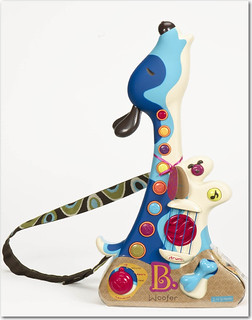
6. Battat Woofer GuitarThis guitar is easy to play and has 20 songs that play in three modes (electric, acoustic, and hound dog howls). Your baby can strum the strings or push the many buttons to explore musical notes and sing along. This very entertaining toy has volume control and an automatic shut off to conserve its 3 AAA batteries that come with it. $32.78 at Amazon.

dishes
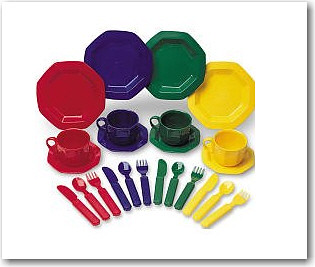
7. Learning Resources Pretend and Play Dish SetEncourage your baby’s developing pretend play with an activity that he is very familiar with, eating! Your baby will have so much fun trying to feed you, or his baby doll, or his stuffed animals with this set of dishes and eating utensils. Pair it up with a play food set such as the Melissa & Doug Birthday Party Cakefor some truly enjoyable imaginative play. $13.42 and $13.59 at Amazon.

whackyball
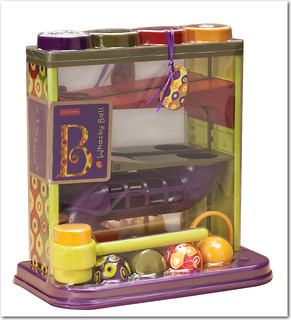
8. B. Whacky BallYour baby will work on her motor skills while she pushes or whacks the balls down into the mirrored maze. Once they pop out into the tray, she can put them back up top and whack them again. The company (B.)that makes this toy (and the Woofer guitar above) gives 10 cents of every toy purchase to Free the Children. $25.39 at Amazon, also available at Target.

chicco
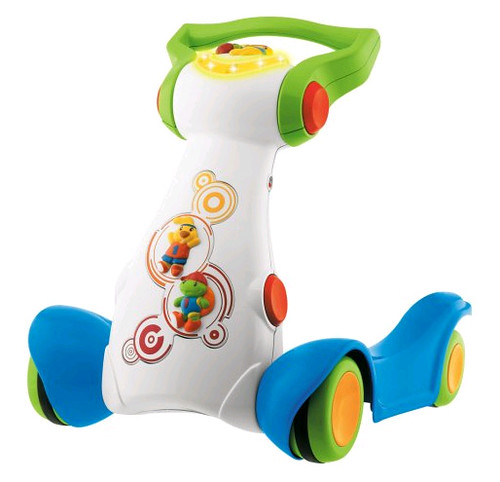
9. Chicco Baby JoggingIf your baby hasn’t taken that first step yet, she will be soon and a push toy is the perfect companion to motivate her to get up and go. Not all push toys are created equal... many tip over, or go too fast but this one will not do either because of its unique design. It also has six different positions so that it can be perfectly set to your baby’s height. Depending on the speed of walking, the lights come on progressively and the rhythm of the melody speeds up or slows down, stopping altogether if your baby stops. Takes 2 AA batteries. $55.77 at Amazon.

fridgefarm
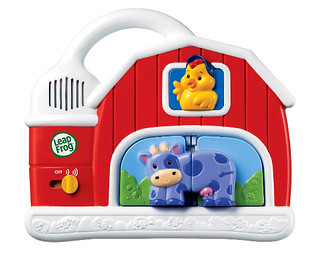
10. LeapFrog Fridge Farm Magnetic Animal SetYour baby can practice matching and placing magnetic pieces into the slots while learning the names and sounds of five farm animals. Even mismatched combinations are rewarded with a silly song. The toy has two different sound levels and takes 3 AAA which are included. $34.50 at Amazon.

carfridge
The LeapFrog Fridge Wash & Go Magnetic Vehicle Set is newer and cheaper this year, and I am guessing (hoping) the quality is the same, so if you can’t find the Fridge Farm at a good price or just prefer vehicles, this is the version for you. $24.99 at Amazon.


Your Turn
Have you started your holiday shopping? Tell us what you got for your little one, or share about a favorite toy you already have.

Saturday, March 26, 2011

Which Walker is Best?

Just because they named it a walker doesn’t mean it will help facilitate independent walking for your child. There are no studies that support the idea that putting your child with Down syndrome in a walker will help him to reach that milestone sooner. In fact there is some evidence that shows that children who use walkers actually learn to walk on their own later than their peers.

Pros & Cons of Walkers
Like any baby contraption that has a seat and some toys attached, a walker can be useful when you need to put your child in a safe, entertaining place while you answer the phone or cook dinner.

If your child is not ready for a walker, there are risks involved with putting him in one. A walker allows your child to bear weight on his joints that he may not be ready for if he does not have the core strength and stability to handle it. These abnormal forces on the joints can cause damage and can also teach your child patterns of posture and movement that are not typical for his development. Most walkers interfere with the child’s ability to see his legs and feet and therefore hinder his ability to receive important motor information about how his body works.

Having your child in a walker for long periods of time can also hamper sensory motor development because it controls what the child can “go for” and puts a barrier between the child and the world around him.

When a Child Can Benefit from a Walker
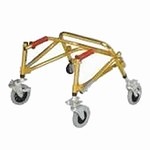
If your child has the desire to be up and moving around and can walk along the couch or coffee table, or can walk while holding on to a push toy, or can walk while you are holding his hands, yet cannot walk independently due to trouble with balance, susceptibility to fatigue, or some other underlying cause for delay, he might benefit from a therapeutic posterior walker.

walkerA posterior walker provides the support and mobility a child needs to be able to walk around, yet does not inhibit proper gross motor and sensory development. A posterior walker should be introduced to your child by a trained physical therapist and his time using it must be closely monitored by a caregiver or therapist.

Ok, So...
Now that you may have changed your mind about buying a commercial walker, you might want to throw the big question out there, “When should my baby walk?” There is a very large age range for this skill and many factors determine when it comes. Some children with Ds start walking as early as 14 months, others are over the age of 4 before they master it. So unless a doctor or therapist has indicated that there may be a secondary cause for delayed walking, be patient... it will come. And, for those times you need to confine your child for his safety (or your sanity), stick with an exersaucer or playpen.

Friday, March 18, 2011

Back in the Saddle

My blog “maternity leave” is officially over... and while I was away so much has been happening in your world. There have been lots of pregnancies, births, and adoptions, many new blogs and new blog addresses, new resources and goodies, and lots of new questions.

So where should I start? First off, if you are pregnant with a baby who has been diagnosed with Down syndrome, if you had or adopted a baby with Ds over the last 10 months or so, or if you have a new blog or blog changes, please email me so we can share your stories.

I have been reading many blogs, catching up with new little ones... and I am reminded of how much milestones seem to matter to us parents in the beginning. We are nervous and wondering how this new child will fare... we still believe that hitting those early marks is important, a sign of how well our baby will “function”. We still have so much to learn and so much to let go of.

With that in mind, I will repost the very first ds.mama post “Stage Not Age”. The link to the development journal has been updated, so if you have already read this post and could not get your copy, try again.

Stage Not Age

One of the first things to get over when you have a newborn with Down syndrome is looking for milestones based on your baby’s age. We have all heard stories about so-and-so’s baby who held his head up before the placenta was delivered and walked at six months old. Most of us have read some form of a What to Expect book and have a general idea of how old a baby is when certain things happen. Flush that knowledge from your mind and try not to pay too much attention to Mrs. So-and-so.

Babies with Down syndrome develop along the same path as a typical baby, meaning they reach most milestones in developmental order but they do it on their own schedule. They also have a lot more milestones to celebrate. Who knew there were a zillion sensory and gross-motor skills that are reached before a baby rolls over? You are going to need a whole bunch more cute stickers for that First Year Calendar than the measly 10 that came with it.

There is an amazingly detailed resource out there for setting expectations for your baby’s development and tracking your child’s progress from birth through about the first five years. It is called the The Developmental Journal for Babies and Children with Down Syndrome. It is put out by the English government program, Early Support. The material is provided for free online in pdf format. When you see the journal you’ll realize that this group has put a ton of research and effort into this project, and you will be thankful to the Brits for this contribution to your resource arsenal.


The journal includes the five areas of development (communication, social-emotional development, cognition and play, motor and sensory development, and self-help) and is categorized by 11 developmental steps. For each item, there are three columns to track your baby’s progress. There is also room for adding notes and questions.


Enjoy your baby's stages because while they sometimes seem like they'll last forever, they won't. And, make sure you go get your journal!

Monday, March 22, 2010

Pooey Looey

Warning: Ya’ll are going to think ds.mama is a bit nuts after this post. But I swear to you as crazy as it seems, it works. And successfully getting my 18 month old with Down syndrome ready to potty train is worth all your laughter and scorn :-)

Ah... potty training, a daunting task to accomplish with any child... Some people see potty training as an event, something you settle down and do one week. Not me... in our house potty training is a process that begins with elimination awareness and eventually ends two years or so later with saying bye bye to pull ups at bedtime.

During our last IFSP meeting, I mentioned that one of my goals over the next six months was to begin pre-potty training... Six shocked faces stared silently at me. Summer was 16 months old and her team was probably trying to figure out how to break it to me that she was nowhere near ready to start potty training.

Little did they know, I have been “pre-potty training” Summer since she was about six months old. I had learned some interesting things about potty training with my first few kids and I decided as each one came along to add to the “pre-potty training” repertoire all that I was noticing. I also had a friend who bravely did the EC method with her only child, and had relative success with it. I thought to myself, why not take the best of all this and see what happens.

Pre-potty training tricks
The very first step you can take, at any early age you choose, is to help your child connect elimination with a special sound. Notice how your infant child acts when he is poopin. There is likely going to be some grunting, wriggling, and a red face. Take the time to identify to your child what is happening. I sing a goofy made-up song to a warped version of the Sanford and Son theme song.... It goes something like, “A poo poo pooey, a pooey looey, a poo poo poo poo poo poo poo, a pooey looey...” Ahem, you get the idea (and yes, I do refrain in public).

If I have missed the event, I sing it when I am changing her diaper. The only time she hears this goofy song is when she is going or has gone poo. Over time, she has made the connection.

The next step is to help your baby associate going potty with a potty-chair in the bathroom. You can begin this step once your baby can sit on a chair or low bench on her own and can understand cause and effect and sequence. (An example of understanding sequence is that your child knows his routine and expects certain things to happen next. I usually start this step around 16-18 months old.)

pottyFind a sturdy, comfy potty chair to keep in your bathroom. Make the sign for bathroom and then put her on the potty (clothes, diaper, and all) when she shows that she is getting busy. Sing the goofy poop song, and imitate her grunting. Yup, you read that right. Do some face to face grunting and then tell her it is her turn. She will imitate you back and you will be happily surprised at the results.
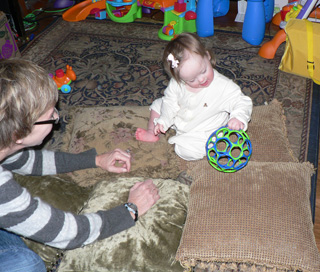
I do not start off doing this every day or for every elimination. When we have the time, and she seems very alert and is in a good mood, I will take her into the potty and let her practice. Sometimes if I am sure she hasn’t already started going, I will let her sit diaperless and actually go in the potty.

My pre-potty training goal is to teach her body to expect to go on the potty when she needs to poo. I have given her elimination awareness, a sign to use, and practice in the position. Next year, when she is ready to start actual potty training, she’ll already have these basics ingrained.

Your Turn
Ok moms who have been there, done that... do tell. How and when did you start potty training, and what worked best for your child?

From Theory to Practice :-)

Tausha: No Way!!! That did not just happen!!

Monday, March 8, 2010

EI—Who, What, When, and Why

The purpose of Early Intervention (EI) is to teach us how to give our little ones the extra support they may need to develop effective motor planning and skills.

pt1

EI starts off with the assignment of an EI service coordinator and an initial evaluation to figure out what therapeutical services will be beneficial for your child. During the evaluation you will be asked what things are important to you and your family concerning your child. Based on this evaluation and your input, a team of therapists is pulled together to help you and your child reach the goals you have set out.

The goals are written up for a six month period in a document called an Individualized Family Service Plan (IFSP). The IFSP is a living document that gets updated every six months (and sometimes sooner depending on any special circumstances) to reflect your families on-going needs and goals.

pt2

It is important to know three things about EI therapists... first of all, they work for you and your child, and you get to decide if the relationship is working out. If you are uncomfortable with a therapist for any reason at all, you can ask your EI service coordinator to switch the provider. Second, not all EI therapists have experience working with children with Down syndrome. And third, there are several concentrations within specific therapy fields. For example, some occupational therapists may have a strong background in sensory, while others may have more experience with self-care skills such as feeding and dressing.

When you are determining who will be working with your child, you should make sure the provider has experience with children with Down syndrome, and a level of expertise in the areas that are specific to your goals. In other words, not any old therapist will do.

pt3

Almost all infants with Down syndrome can benefit from working with a physical therapist (PT) and a speech and language pathologist (SLP) with a background in newborn feeding and oral motor skill development. Some infants may benefit from spending time with an occupational therapist (OT) who can provide a sensory program that includes deep pressure and brushing. Between 8 to 10 months of age, you probably should start pushing for a special instruction teacher. This educator will use play therapy to begin teaching your baby sign language, concepts such as in/out and up/down, as well as choice-making and other cognitive skills.

When EI is working right, you will find that you have a team of encouraging therapists who are:
—showing you at a detailed level all of the amazing developments your baby is achieving.
—training your child’s neurological pathways in effective motor activity and motor planning.
—teaching you how you can incorporate basic skill development into your baby’s everyday routines.
—teaching you how to provide your child with motor training, and sensory and cognitive experiences and that will help him develop constructive life skills.

pt4

EI is not about pushing your baby to the next big milestone, it is not about comparing your child to others, and it is not about making you feel inadequate as a parent. If you are experiencing those things, it may be time to consider some changes to your child’s team.

Your Turn
When did you start EI and what services did you start off with? What have been the pros and cons of EI for your family?

Monday, February 8, 2010

Oral Motor Myths

Myths... a high-arched narrow palatal vault (that would be the “roof” of the mouth), tongue protrusion, mild to moderate conductive hearing loss, chronic upper respiratory infections, mouth breathing, habitual open mouth posture, and the impression that a child's tongue is too big for his mouth... all myths.

Speech and language pathology expert, Sara Rosenfeld-Johnson published an article back in 1997 titled, The Oral Motor Myths of Down Syndrome. In the article she lists seven structural/functional disorders (the myths above) that she feels can be prevented.

In other words, infants with Down syndrome are not born with these oral motor differences; instead they develop them based on inappropriate therapeutic approaches to feeding difficulties present at birth due to low tone.

Rosenfeld-Johnson writes, “Orally, these children look pretty much like any other infant with the exception that they have a weak suckle. This critical observation draws us to the connection between feeding muscles and muscles of speech. In quick order, a cascade of events unfolds for these babies with weak suckle.”

The events she refers to begin with making it as easy as possible for the newborn to eat which sets in motion a downward spiral of circumstances that lead to the development of the above-named oral motor irregularities.

There is an assumption in the medical community that babies with Down syndrome do not eat well, and that they inevitably demonstrate all or most of the seven structural/functional disorders seen in many people who have Down syndrome. Because successful nutritional intake is one of the primary goals that needs to be reached ASAP with a newborn, nurses and doctors often push solutions that may be in direct conflict with the best oral-motor therapy techniques for improving a baby’s oral motor skills.

I can tell you from experience that this is true. I had a baby with severe heart defects that could not eat enough on her own to survive. She could not successfully nurse, nor would she drink well from a bottle. I did not know about Sara Rosenfeld-Johnson’s theories. If I had known, I would have used them as support for my stubborn ideas about feeding and continuous oral motor stimulation.

So what are SRJ’s recommendations?
1. When a baby is being fed, his mouth must always be lower than his ears.

2. A breastfeeding mom should stimulate the mammary glands while her baby is nursing to increase milk flow. Over time, as the baby’s strength increases, gland stim will no longer be necessary.

3. A bottle-feeding parent should use bottles with disposable liners. This allows the air to be pushed out of the bottle causing a vacuum and making it possible to feed in a position where the bottle nipple is presented from below the mouth. The caregiver can push gently against the liner if necessary to facilitate the flow. Rosenfeld-Johnson explains, “This position encourages a slight chin tuck and the child draws the milk up the nipple predominately with tongue retraction. This position and retractive action prevents milk from flowing freely into the child's mouth. The child no longer needs strong tongue protrusion to enable swallowing. It is also important not to make the hole in the nipple larger.”

The article clearly explains how feeding approaches can alter your baby’s future both positively and negatively, making it a valuable read.

Your Turn
Can following these fairly simple suggestions have a significant effect on your baby’s future oral motor structural and functional formation? My child’s oral motor development has been consistent with what was presented in the article, so based on that (and the fact that the points in the article made sense) I would say give it a try.

What about you? Did you by chance feed from birth according to SRJ’s method? Did you not? Does your child exhibit any of the mythical characteristics, or not?

Wednesday, January 20, 2010

Communication 101

sam_teleParents look forward to hearing that first word... “dada” or perhaps “mama”. And when it comes, we are thrilled because we know that our child has connected words to objects, and that the rest of our spoken language is just a matter of time. But it is important to remember that speech is just one component of communication, and usually the last piece to be mastered.

The first communications between mom and baby begin at birth with cries, rooting, facial expressions, and eye contact (and maybe even before birth since we know that a newborn can recognize his mother's voice). While these first methods of communication come naturally, for babies with Down syndrome the presentation might be fainter or appear later than expected. For example, the smile is one of the first communication signals a baby gives us and it is important to realize that babies with Ds might smile later, less frequently, and less boldly than other children. The difference between a parent’s expectations and a baby’s skills can disrupt the mom’s ability to interpret her baby’s signals, making it harder for a harmonious relationship to develop.

What’s a Mom To Do
Like we do with all new love relationships, spend time studying your baby’s expressions and movements. Become sensitive to whatever communiques your baby is giving and respond to them accordingly with both words and gestures. It won’t be long before your baby figures out that he is the cause of these positive results. And so begins what we call “communicative intent”, using communication with the intention of affecting the environment.

Irene Johansson, author of “Language Development in Children with Special Needs”, suggests tactile intervention in the form of newborn massage several times a day. This provides the opportunity for the caregiver to communicate with the baby while the baby is experiencing a physical stimulation that heightens his awareness.

Requesting/Protesting
It is imperative to encourage a baby’s desire to communicate. The best way to do this is to be very responsive to him when he initiates any of the natural communiques of requesting and protesting. Don’t let him cry it out or make him wait if you can help it. Reward him with a smile, caress, or song whenever he is looking at you, kicking his feet or reaching out. Don’t worry about spoiling your baby by always giving quick and direct feedback. You cannot spoil a newborn with too much responsiveness or attention. And patience is a virtue that can be practiced after your child learns that communication is power.

Gazing
jmphoneBabies learn a lot about communicating by watching you do it. Research has shown that babies are predisposed to face watching. You can encourage your baby to look at you by keeping him close to eye-level in a carrier, or in a babyseat that is up on a table. If your baby doesn’t have the strength or coordination to watch you, hold her in a position that gives good support to her head and neck. While you are gazing at each other imitate any facial movements she makes, or stimulate her by making noises and expressions. Babies with Ds initiate less often, so take the lead and start a “conversation” whenever you get the chance.
Turn taking
Another important part of communicating is taking turns. You can work on this with your baby by pausing while speaking to him, as if you were listening to his response. You can also practice turn taking by shaking a rattle and then helping your baby to shake his rattle, back and forth several times. This builds the expectation of response, teaching your baby that communication results in response, or rather having your needs and wants met in some way.

Performative Communication
Performative communication is defined as the “speaker’s” deliberate, conscious, and goal-oriented use of communication (speech, signing, picture cards, body language, etc.)(Snyder 1978). Irene Johansson’s book is a week by week program for providing your baby with communication intervention that begins at birth. She makes a great case for why you would want to use her model (which incorporates massage, structured sounds, movement, and more) to help your baby develop strong communication skills.

I did not have this book when Summer was a newborn, and it wouldn’t have mattered because I do not have the discipline to follow such a structured program. However, that said, I have used some of the suggested program for the last year, and believe that for a caregiver who can do it, there would be worthwhile benefit.

Your Turn
Have you posted about a communication topic? Let me know and I will link to you.

To Love Endlessly: Communication
Face the Sunshine: Sign on...

Picture credit: Marissa from To Love Endlessly
John Michael from Monkey Musings

Thursday, January 7, 2010

Toothfairy Gone Mad

Since she comes to collect precious baby teeth when they fall out, I am guessing the toothfairy has something to do with making those little tooth buds while babies are cooking in utero. Surely the fairy dust she sprinkles on the gums of babies with Down syndrome must be quite magical because it causes some interesting tooth development.

Babies with Down syndrome often have their teeth come in late (nursing mothers stand up and cheer!) You can expect your baby’s teeth to arrive in any old order they choose, including perhaps not at all for some teeth. (Uh, maybe that fairy got a little too wild with her wand...) And, some teeth may be irregular... as in extra sharp, big, small, or even funky shaped.

What does all this mean (aside from that the toothfairy needs to stop partaking of fairy dust before going to work)? Not much for the under 10 months crowd because tooth eruption tends to be delayed in children with Ds. Babies without teeth can still eat anything that can be mashed by powerful gums and that includes soft well-cooked meats. Your baby can still hurt you by biting you with her gums (nursing mothers can stop cheering now.)

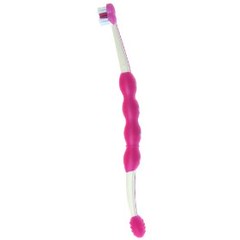
mam_toothbrushOnce your baby’s teeth start arriving, sometimes molars first as was the case with Summer, you should brush them after meals and bottles. (Uh huh, fun fun.) There are lots of baby toothbrushes out there to choose from. Our pediatric dentist recommends the Mam Training toothbrush ($5.99 at Amazon.com as part of a set) and I find it easy to use. It has a long handle and a rounded brush on one end, as well as a gum massager on the other. And don’t forget to floss your baby’s teeth (more fun). I prefer to use floss rather than the fancy new disposable flossers that are out there mainly because it is easier to maneuver around with it in a wriggly baby’s mouth. Good luck finding kid-friendly flavored floss at the drugstore... I score the bubble gum variety when we take the older kids to the dentist. However, since babies with Ds tend to enjoy strong flavors, cinnamon or mint probably works just as well.
There is really no pressing reason to visit a dentist prior to age three (unless some teeth do not come in) but you may want to start shopping for a pediatric dentist who has experience with children who have Ds. We visited a dentist at 15 months because there were signs that teeth might be missing. The dentist confirmed this to be true and suggested X-rays at age two. (We won’t need to do that because she got them for Christmas.) So aside from blog research, some incorrect dental conclusions, and a fancy toothbrush, I can’t think of any good reason to go back before age 3... unless of course, that the toothfairy comes back around and does something crazy with her wand.

Your Turn
While you are here, please take the tooth poll located over in the upper left column. If you leave me a comment saying that you participated in the poll (or that you would have if your baby already had that first tooth :-), you will be entered into the Winter Giveaway. The winner will receive a First Years Star Teether, a NUK straw cup, and bubblegum flavored dental floss. (You are invited to take the poll even if you aren’t interested in the giveaway.)

Monday, November 30, 2009

Dear Santa Claus,

Once your baby can sit or has better body and head control, you can introduce stage two toys. (Not here yet? Check out the stage one toy recommendations. Or if you have already moved on to the next stage, check out these toys.) I’m going to list 10 toys you might want to put on your baby’s Christmas... Hanukkah, Kwanzaa, Three Kings Day... list. Though this post comes too late for Eid-el-Fitr (and Black Friday), you will hopefully still get some good ideas from it.

Fisher Price—Roll-a-Rounds Swirlin Surprise Gumballs
sheridan_gumball
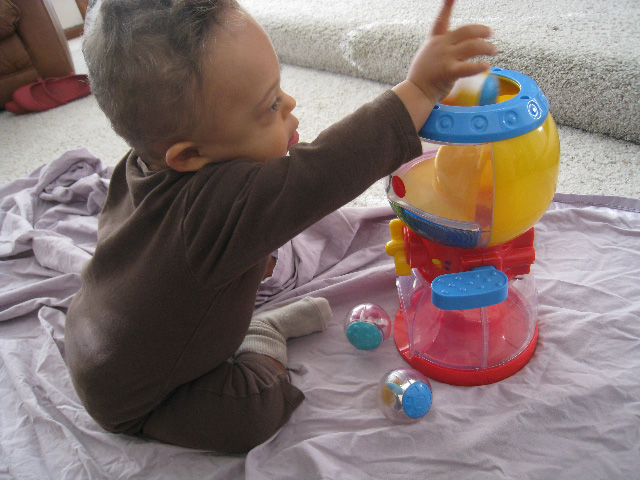
Lights! Action! Wow! This oversized “gumball” machine releases four see-through balls that have “candies” in them. Each time your baby taps the lever, he is rewarded with lights, music, and a gumball that swirls around as it makes its way out of the dispenser. This toy teaches cause and effect, as well as the concept of in/out. The lights and sounds can be turned off and the volume has two settings. Comes with 3 AA batteries (but the ball dispensing would still work with no batteries). $22.99 Toys-R-Us
Picture credit: Sheridan from Genetically Enhanced

Fisher Price—Little Superstar Sing-Along Stage
music table
This toy gets an A+ for entertainment value as it will keep your baby interested for long periods of time. It also gets high marks for teaching cause and effect, encouraging self-recognition and communication, and promoting sitting, reaching, and fine motor hand control. For an in-depth description of this toy, check out Ria’s review. (3 AA batteries included) Overpriced ($83) at Amazon.com. Look for it in-store at Toys-R-Us.

Slinky
slinky2
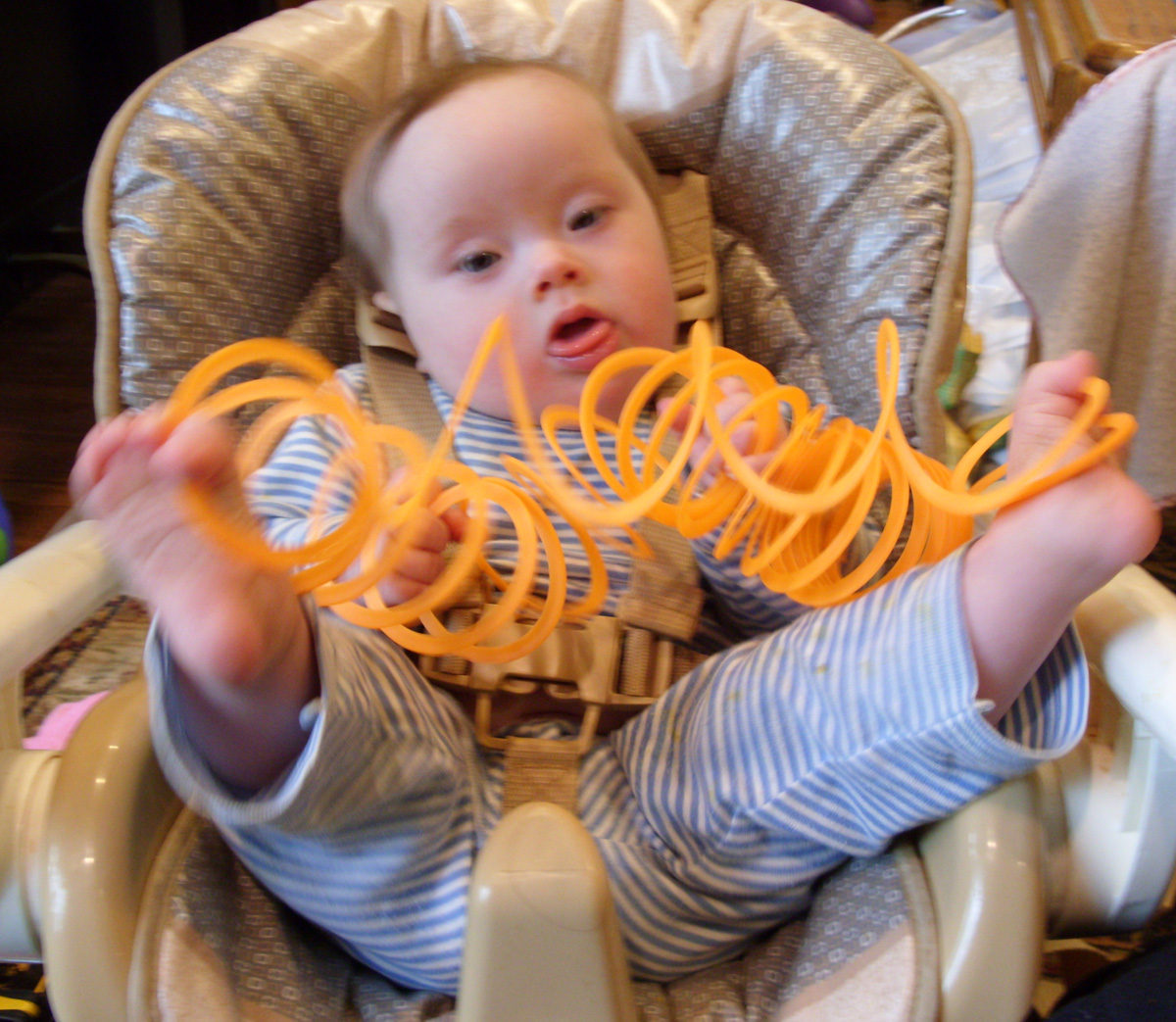
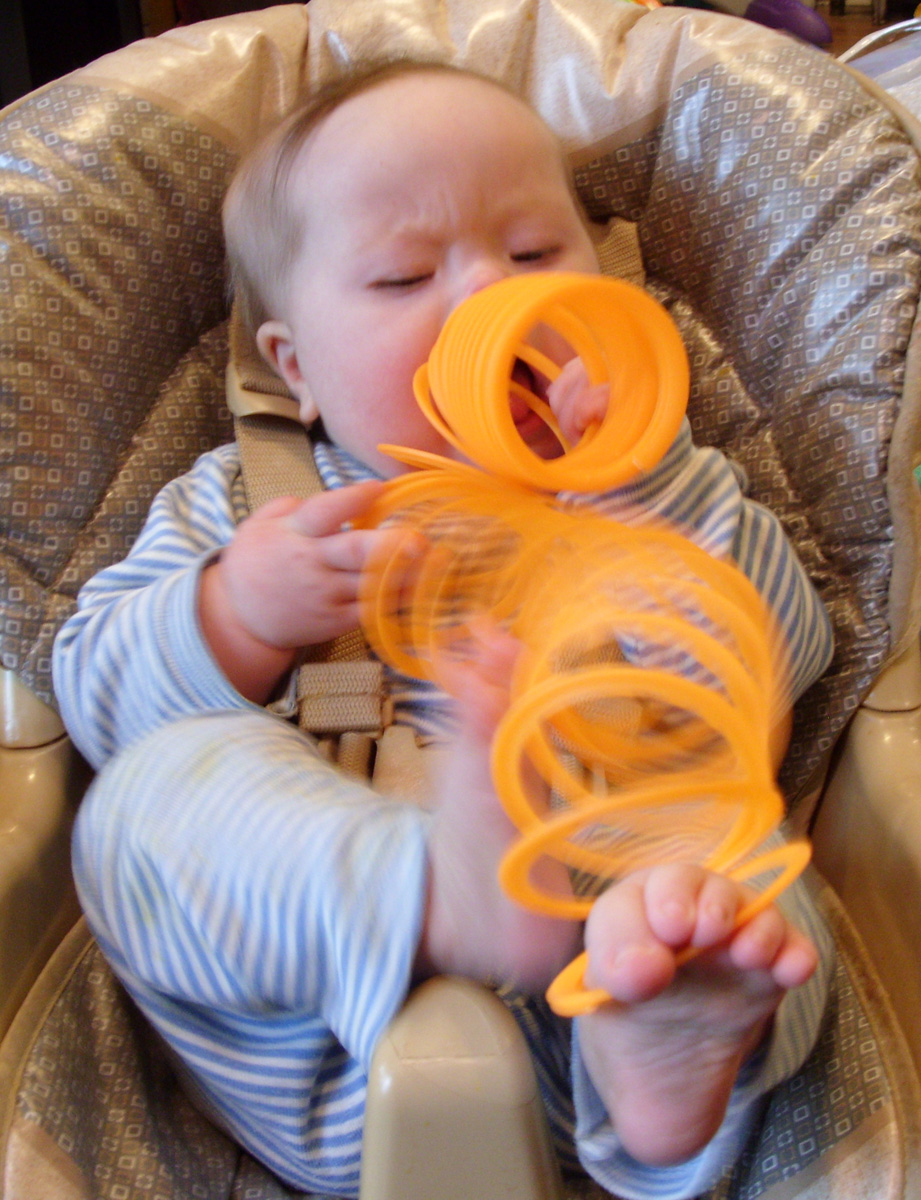
slinky1Who knew a slinky could be so much fun? Put your baby’s amazing feet to work with this toy and then sit back and enjoy the show. The plastic version comes in two sizes, several bright neon colors, and is easy to untangle. This toy encourages your baby to practice gross and fine motor skills, but even if it didn’t have any therapeutic or educational value, I’d still recommend it because it is the most fun your baby can have for five dollars :-) Small plastic version, $4.99 Toys-R-Us

Fisher Price—Rainforest Jumperoo
jumperoo
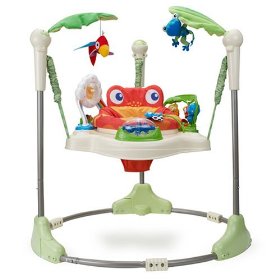
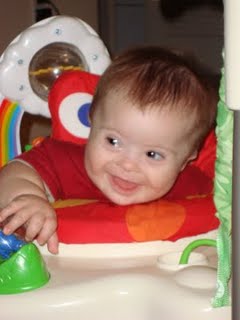
DSC01400Many babies with Down syndrome love to bounce and the Jumperoo provides the perfect opportunity for it. Once your baby has good core strength, he’ll enjoy pushing off with his feet and bouncing himself like crazy. The jumper has lights and sounds with various settings, but your baby might be too busy jumping to notice!. Babies up to 25 lbs. and 32 in. can enjoy this toy. (3 AA batteries not included) $69 at Amazon.com
Picture credit: Joey from Our Bundle of Joey

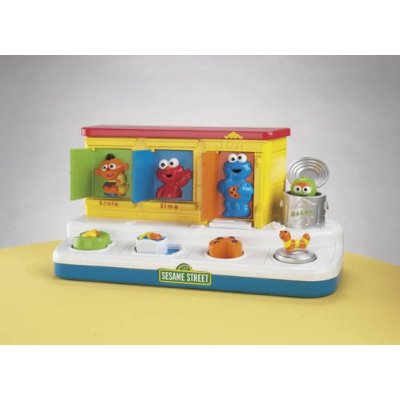
Fisher Price—Sesame Street Singing Pop-Up Pals
popuppals
This pop up toy features Sesame Street figures who sing clips of their songs when they pop out. The toy teaches cause and effect and prompts your baby to practice his fine motor skills to twist, press, click, and slide the knobs. The characters’ doors close in two different ways adding to your baby’s coordination skills. The sound can be turned off and the pop ups still work (nice feature for when you run out of the 3 AA batteries that come in it). $21.99 at Toys-R-Us

Fisher Price—Moo Sounds Milk & Cookies
moocow
Who stole the cookies from the cookie jar? Your baby will! This little jug comes with 5 cookie-shaped colored discs that your baby can put in and take out. For beginners the jug opens up completely and for those who have practiced a bit, the cover fits on with just a cookie-sized slot in it. When you dump the cookies out, the jug “moos”. This is a great way to work on the concept of in/ out, colors recognition, and beginning counting, while also working on the coordination skills of targeted placing and reaching for objects. (2 Alkaline Button Cell batteries included) $9.99 at Target

Melissa & Doug Nesting Boxes
nestingboxes
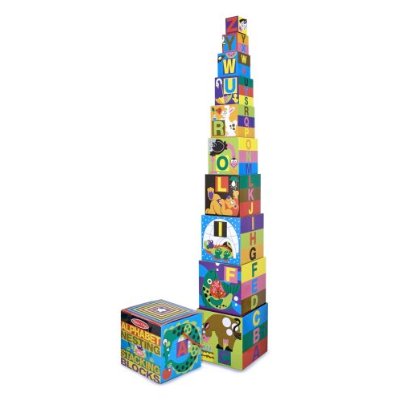
What’s more fun than building a tall tower? Knocking it down of course! Your baby will likely master the destruction part of this game before the building part. That’s ok because she has you to stack and restack the boxes for her :-) Eventually she will learn to stack the boxes and to nest them by herself. You can work on the concepts of up/down and in/out with this toy, as well as practicing the motor skills necessary to build and knock down the boxes. These nesting boxes have the alphabet on them and lots of pictures that you can use to teach some common words to your baby. Melissa & Doug Deluxe 10-Piece Alphabet Nesting and Stacking Blocks are $9.99 at Amazon

Fisher Price—Stack 'n Surprise Blocks Songs 'n Smiles Sillytown
blocks
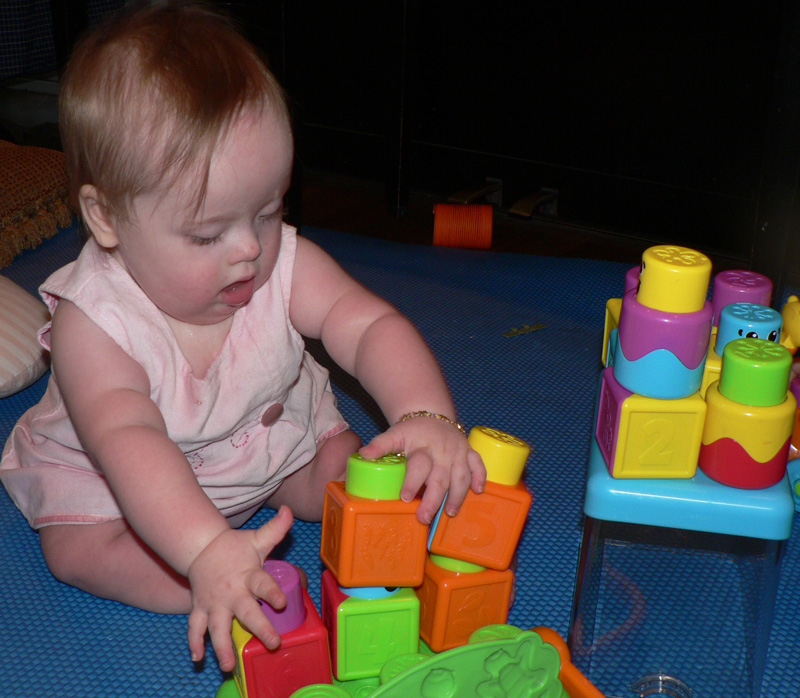
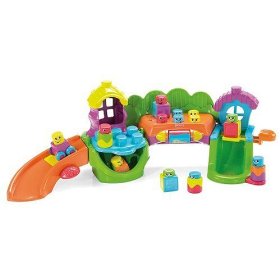
sillytownPop up, peek-a-boo, stacking, music, lights, and a race car... there is much to do with this toy. Your baby will practice fine motor skills, hand-eye coordination, and cause and effect. This set comes with 8 stacking blocks (one that is a car) and features a pop up section and a tumble down section, as well as a car ramp, and a stacking shelf. After seeing how much fun Summer (and her 3 yo brother :-) had with the Count and Build Snail Pail set, I knew this one would have a spot under the tree this year! (3 C batteries included) Songs ‘n Smiles Sillytown is about $40 at Walmart and the Count and Build Snail Pail is $19.97 at Amazon.com

Munchkin Mozart Music Cube
cube
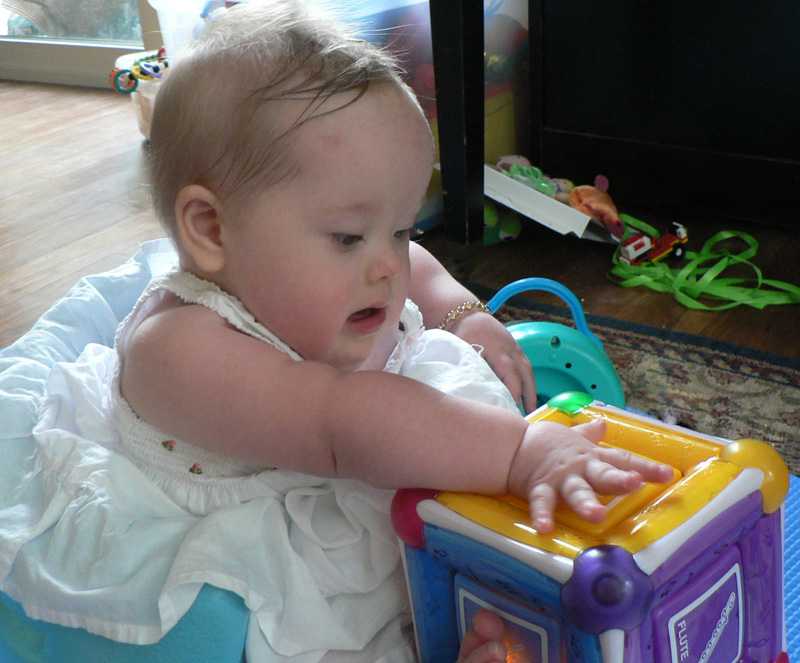
Music therapy here we come :-) This cube features 5 individual instrument buttons: harp, flute, French horn, piano and violin, and an orchestra button that plays all the instruments at once. It has 8 Mozart compositions and the lights flash in rhythm will the songs. The buttons are big and easy to push with hands or feet. The toy teaches cause and effect as well as the different sounds instruments make. (3 AA batteries not included.) $15 at Amazon.com

Discovery Toys—Go Go Caterpillar
gogocat
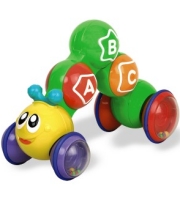
Our PT brought this toy over one day and Summer was very interested in playing with it, though for a while she seemed a little mad that it “ran away” :-). If you are ready to urge your baby to crawl or scoot, this is a good toy to have. Your baby can make it roll away by gently pressing on its back. The wheels are filled with beads that fly around as the caterpillar zooms across the floor. The toy reinforces the concept of cause and effect, and prompts your baby to strengthen his gross-motor "Go Go Baby" muscles. $15 at Discovery Toys


And Santa, please bring shares of Fisher Price stock for mom and dad...

Your Turn
Got a favorite stage two toy recommendation for Santa? Want to tell us what gifts are you giving to your children with Ds this year? Please do, inquiring minds want to know :-)