Showing posts with label nursing. Show all posts

Wednesday, March 7, 2012

Breastfeeding Your Baby with Down Syndrome - Part Two

Last week guest blogger Lisa Morguess from Life As I Know It shared her personal story of overcoming several obstacles to develop a breastfeeding relationship with her son Finnian. This week she shares with us some of the tips and resources she found helpful.

----------------------------------------

Tips and Tricks
~ First and foremost, if anyone tells you that breastfeeding your baby will not work because she has Down syndrome and you have your heart set on breastfeeding, walk away. Believe it can be done; plenty of moms have successfully nursed their babies with Down syndrome.

~ Find a good lactation consultant, preferably one who has some knowledge about Down syndrome and the unique challenges that can be associated.

~ Experiment with different nursing positions. There is no one position that works for all moms or all babies. I had the most success when Finn was a newborn with the cradle hold, the cross-cradle hold, and the football hold. I found the football hold especially useful when using a SNS/LA, and the cross-cradle hold when using breast compression.

~ Breast compression is an effective way to increase your milk production and increase baby's intake. It works by manually compressing the breast as baby is nursing, slowly and repeatedly, thereby stimulating milk production and encouraging a baby who may have a weak suck to take in as much milk as possible.

Useful Contraptions and Accoutrements
~ A good breastfeeding pillow is a must. A Boppy probably won't cut it, as the low muscle tone associated with Down syndrome necessitates a very firm foundation on which to support your baby. I highly recommend the My Brest Friend pillow.
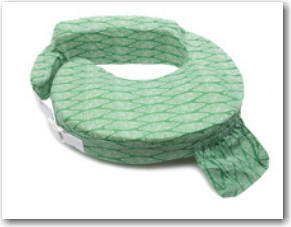
friend_pillow

~ Some babies with Down syndrome do better with the sensory input of the more rigid shape of nipple shields. Using the shields is usually only short-term, while a newborn is learning to efficiently latch and suck.

shield

~ Sometimes it is necessary to use a supplemental nursing system (SNS), also known as a lactation aid. If your baby is having an especially difficult time with latch and/or suck, and because of this she isn't gaining weight appropriately and your milk production is diminishing, an SNS might help. The SNS allows baby to receive supplemental milk while at the breast, and this in turn stimulates milk production. If you need to use an SNS, try making your own instead of buying one. The ready-made systems are difficult to use and they're not cheap. A homemade one is inexpensive, easy to make, and easier to use.

A breast pump is a must for any breastfeeding mom, for those times when you are separated from your baby (for a variety of reasons), and need to keep your milk production “on schedule.” If your baby has any medical issues that require a separation from you, it will be extremely important to establish milk production as soon as possible by pumping your breasts at regular intervals (or if the separation is later, for instance due to heart surgery, it will be important to keep your milk production going). A breast pump is also extremely helpful in establishing and maintaining your milk production while a baby who has any feeding/latch/suck difficulties works out the kinks. Though I won't recommend a particular brand, I do encourage getting an electric double pump, as they are far more efficient and effective than manual breast pumps. You can rent a hospital grade pump from almost any hospital for a nominal cost, or you can buy one new from a variety of websites and baby stores, and you can even buy a used one at a discount on eBay or Craig's List. When you buy a used pump, you're basically buying the motor; you will need to buy your own new, sterile tubing, collection bottles, and breast shields.

Supplements to Increase Milk Production
A well-balanced diet and ample fluid intake are necessary for sufficient mild production. If you find, that your milk production is lacking (which often happens when a baby has feeding difficulties), herbal supplements can help, including fenugreek and blessed thistle taken together. These herbal supplements are available in capsule and tincture form from any health food or whole foods retailer.

If herbal remedies don't do the trick, there is Domperidone (Motilium), a prescription drug whose intended use is treating certain gastrointestinal issues. It has an off-label use of increasing milk production in lactating women. (The FDA issued a warning at some point against using it for this purpose, and I'm not going to go into the ins and outs of that particular issue except to say that it has been used safely by a great many women who may not have been able to successfully nurse their babies otherwise. I used it for over two years and never suffered a single side effect.) If your doctor does not want prescribe it for you to increase milk production, it is available without a prescription from various international pharmacies online. Be assured that this is perfectly legal. The pharmacy I used to obtain Domperidone was inhousepharmacy.biz.

Some Wonderful Resources
International Breastfeeding Centre
Breastfeeding Inc.
Breastfeeding Online
Kelly Mom
La Leche League


Wednesday, February 29, 2012

Breastfeeding Your Baby - Part One

In part one of this two post series on breastfeeding a baby with Down syndrome, guest blogger Lisa Morguess from Life As I Know It shares her personal challenges and triumphs nursing her son Finnian. Next week in part two, she gives practical advice on how to establish and maintain a successful breastfeeding relationship with your newborn.
-------------------------------------------

One of the many widely-held misconceptions about Down syndrome is that babies with Down syndrome won't be able to breastfeed. Though breastfeeding a baby with Ds can be challenging, I would like to offer some encouragement to expectant and new moms of babies with Down syndrome who would like to breastfeed.

I'm not a medical professional or a trained lactation expert… but rather just a mom who, before my own son was born with Down syndrome, successfully nursed five babies for the long haul, and was determined to breastfeed my sixth baby, Down syndrome or not.

Not every baby with Down syndrome is faced with difficulties in breastfeeding but for those who are, the two main things that hinder breastfeeding are low muscle tone, and immediate and prolonged separation of mom and baby due to issues the baby might have that require a stay in the NICU. Finnian and I were challenged with the latter issue.

Finn was born at home, where he stayed for roughly half a day before we had to rush him to the ER because he was spitting up blood. In the first few hours after his birth, he was so sleepy that he never really woke up enough to latch on well and nurse. In the ER he was hooked up to all kinds of tubes, wires, and monitors and by that evening, he was diagnosed with a duodenal atresia. He was admitted to the NICU and had corrective surgery the following morning.

For several days, while his intestines healed from this major gastric surgery, he was fed intravenously and I was not allowed to attempt nursing. My milk came in during that time, and I began pumping at regular intervals around the clock and storing my milk for him. I was told that he'd most likely have to start with bottle feeding, and it became clear to me pretty quickly that we had some major challenges ahead of us.

I was heartbroken at the prospect of not being able to nurse Finn. For me, breastfeeding is a huge part of how I mother my babies, and I could hardly fathom not being able to share that with Finn.

When Finn was cleared to tolerate oral feeds about a week after his surgery, the nurses in the NICU were supportive of my desire to breastfeed; however, it was frustrating because everything in the NICU had to occur by the clock and by the numbers. He had to be fed on the schedule the nursing staff set down for him, and if I couldn't make it to the hospital in time, he was given a bottle (of my breast milk). If I was there to nurse him, he had to latch on within a certain number of minutes or I was made to call it quits and give him a bottle. The same went if he didn't take the prescribed number of ounces in the time allotted. It was all very stressful, and I spent a lot of time crying. The stress and the pressure didn't go very far in helping us get a good breastfeeding relationship established. There were lactation consultants on hand, and they were helpful, but all in all, it was a frustrating, discouraging situation.

Convinced that Finn would do better at home where I could nurse him around the clock without the constant supervision and vigilance of the nursing staff, I couldn't wait to get him out of the hospital. By the time he was discharged twelve days after he had been admitted, we were nursing, but it was hit or miss. I was using nipple shields because he seemed to do better with the rigid shape of the shields, which were similar to the bottle nipples he was already becoming used to. I would nurse him and then my husband would follow up with a bottle of expressed breast milk to make sure he was getting enough.

As I suspected, he did seem to do better once we got home, and within a couple of days I was able to ditch the nipple shields. He was latching on well (it seemed), and nursing well (it seemed). It wasn't long before we stopped supplementing with bottles of breast milk, and I was exclusively nursing him.

lm

It soon became clear that he wasn't gaining weight. He had weighed 6 pounds at birth, lost the typical several ounces that babies lose directly after birth, then lost more after his surgery. I think in the NICU he went as low as around 5 pounds. By the time he was discharged, he was back up to his birth weight, but after a week at home, he was still at 6 pounds. Then after another week or so, he had only gained another ounce or two.

I'll never forget our pediatrician - whom I love for the most part - sending me home with several cans of formula and telling me that Finn most likely just wasn't going to ever be able to nurse well because of his Down syndrome. I was devastated. None of my babies had ever received formula, and I felt like a failure.

Fortunately, my midwife insisted that: (a) if I was going to supplement, it should be with the breast milk I had stored while Finn was in the NICU, and (b) I needed to find a really good lactation consultant. I did both. I found a lactation consultant who refused to believe that Finn couldn't nurse simply because he has Down syndrome. Yes, it was going to be a challenge, but it could be done, she insisted.

The LC set me up with a supplemental nursing system (SNS) and spent oodles of time with me and Finn over the course of several appointments, observing us and giving me tips on positioning, etc. With her help, Finnian and I were able to overcome the hurdles that were in place.

Despite my perception that Finn had learned how to latch and nurse well, it apparently wasn't the case, and because he actually wasn't latching properly and his suck wasn't great, my milk production went down, so he wasn't getting enough, and the cycle was set in motion. Even after Finn’s latch improved, my milk production did not recover and I began taking herbal supplements to increase yield. Supplements helped to a degree for a time, but eventually I turned to Domperidone which helped immensely, and was the final missing puzzle piece for us.

Finn nursed until he was thirty-three months old when he self-weaned, which was bittersweet for me because he was going to be our last baby (he is not though... you never know what life is going to throw at you!). Getting breastfeeding going was definitely an uphill battle for us, but through perseverance and good support, we were able to make it work, and it was completely worth it to me.
---------------------------------------------

Tune in next week to get the specifics you’ll need to overcome complications and breastfeed your baby with Ds.

Friday, February 24, 2012

Breastfeeding Polls

Next week begins a two-part series on breastfeeding a baby with Down syndrome. To get ready there are a couple polls on nursing over in the left column. Please take a moment to share your experience in the polls.

Because breastfeeding can be complicated there are several ways to answer the question: did you breastfeed? For the purpose of this poll, the question is did your baby end up nursing from your breast? Even if you used nipple shields or an SNS feeder, please still select one of the options indicating that you were able to breastfeed.

We would love to hear your thoughts on your breastfeeding experience, so please leave them in the comments section.

Wednesday, June 16, 2010

Eat Your Choline

Are your pregnant with a baby who has Down syndrome, or nursing a newborn? A recent study performed by Cornell University has shown that more choline given to developing babies with Down syndrome has lasting cognitive and emotional benefits.

Where can you get choline? There is a lot of it in eggs, beef, cauliflower, navy beans, tofu, almonds, peanut butter, and in Nutrivene-D. The recommended daily dose of choline for infants is about 150 mg a day. For pregnant moms it is 450 mg and for lactating moms it is 550 mg.

I am not sure how many eggs or how much beef liver you would have to eat to pass that much choline to your baby through breast milk, so you may want to ask your pediatrician if Nurtivene-D is right for your child.

To get you started eating your choline, here are two recipes:
For baby...
Vegi Puree (32.3 mg total choline)
1 oz. breast milk (4.5 mg choline) or milk (4.0 mg choline)
1oz cooked navy beans, mashed (8.6 mg choline)
1oz cooked cauliflower, mashed (10.9 mg choline)
1oz cooked carrots, mashed (2.5 mg choline)
1oz cooked sweet potato, mashed (3.7 mg choline)
1tbsp melted butter (2.6 mg choline)
Put in all in the food processor or blender and puree it until you reach the consistency your baby likes.

For you... (and baby, lol)
Nigerian Baked Beans whose leftovers become Summer Stew (284 mg total choline)
(from Madhur Jaffrey's World Vegetarian (modified by L.L.Barkat)
summerstewllbarkat

(ds.mama substituted navy beans for Great Northern beans and shortened the cooking time.)
Stir briefly over low heat..
1 onion, chopped and already sauteed until light brown (5.7 mg choline)
4 cloves garlic, minced (2.8 mg choline)
1 TB curry powder
Add onion and garlic mixture to...
1 1/2 cups dried Navy Beans, already soaked and cooked until tender (retain cooking water) (144 mg choline)
2 tomatoes, chopped (16.4 mg choline)
1 1/2 TB peanut butter (15 mg choline)
salt and pepper to taste
Bake all together about 45 minutes or until tender and sauce is thickened.

For Stew the Following Evening... ( adds about 100 mg choline)
• cut 4-5 potatoes (22 mg choline per potato) into 1/2 to 3/4 inch chunks, add to beans with enough water to cover, and cook 15 minutes or until tender
• garnish with one onion sliced very thin, browned until crisp
• add a generous scoop of herbed butter (5.2 mg choline) and stir until melted

Picture credit: L.L. Barkat.

Monday, February 8, 2010

Oral Motor Myths

Myths... a high-arched narrow palatal vault (that would be the “roof” of the mouth), tongue protrusion, mild to moderate conductive hearing loss, chronic upper respiratory infections, mouth breathing, habitual open mouth posture, and the impression that a child's tongue is too big for his mouth... all myths.

Speech and language pathology expert, Sara Rosenfeld-Johnson published an article back in 1997 titled, The Oral Motor Myths of Down Syndrome. In the article she lists seven structural/functional disorders (the myths above) that she feels can be prevented.

In other words, infants with Down syndrome are not born with these oral motor differences; instead they develop them based on inappropriate therapeutic approaches to feeding difficulties present at birth due to low tone.

Rosenfeld-Johnson writes, “Orally, these children look pretty much like any other infant with the exception that they have a weak suckle. This critical observation draws us to the connection between feeding muscles and muscles of speech. In quick order, a cascade of events unfolds for these babies with weak suckle.”

The events she refers to begin with making it as easy as possible for the newborn to eat which sets in motion a downward spiral of circumstances that lead to the development of the above-named oral motor irregularities.

There is an assumption in the medical community that babies with Down syndrome do not eat well, and that they inevitably demonstrate all or most of the seven structural/functional disorders seen in many people who have Down syndrome. Because successful nutritional intake is one of the primary goals that needs to be reached ASAP with a newborn, nurses and doctors often push solutions that may be in direct conflict with the best oral-motor therapy techniques for improving a baby’s oral motor skills.

I can tell you from experience that this is true. I had a baby with severe heart defects that could not eat enough on her own to survive. She could not successfully nurse, nor would she drink well from a bottle. I did not know about Sara Rosenfeld-Johnson’s theories. If I had known, I would have used them as support for my stubborn ideas about feeding and continuous oral motor stimulation.

So what are SRJ’s recommendations?
1. When a baby is being fed, his mouth must always be lower than his ears.

2. A breastfeeding mom should stimulate the mammary glands while her baby is nursing to increase milk flow. Over time, as the baby’s strength increases, gland stim will no longer be necessary.

3. A bottle-feeding parent should use bottles with disposable liners. This allows the air to be pushed out of the bottle causing a vacuum and making it possible to feed in a position where the bottle nipple is presented from below the mouth. The caregiver can push gently against the liner if necessary to facilitate the flow. Rosenfeld-Johnson explains, “This position encourages a slight chin tuck and the child draws the milk up the nipple predominately with tongue retraction. This position and retractive action prevents milk from flowing freely into the child's mouth. The child no longer needs strong tongue protrusion to enable swallowing. It is also important not to make the hole in the nipple larger.”

The article clearly explains how feeding approaches can alter your baby’s future both positively and negatively, making it a valuable read.

Your Turn
Can following these fairly simple suggestions have a significant effect on your baby’s future oral motor structural and functional formation? My child’s oral motor development has been consistent with what was presented in the article, so based on that (and the fact that the points in the article made sense) I would say give it a try.

What about you? Did you by chance feed from birth according to SRJ’s method? Did you not? Does your child exhibit any of the mythical characteristics, or not?

Tuesday, May 26, 2009

Nursing Tips

Nursing can be a frustrating experience for both baby and mother when it doesn’t go smoothly. For some newborns there are obstacles that must be overcome or mitigated before they can successfully breastfeed. It is important to have realistic expectations in order to not become discouraged and give up. It can take up to 4 or 5 months before some babies reach the turning point and are able to nurse without special support or guidance. The key to achieving a breastfeeding relationship is patience and persistence.

For a mother who wants to breastfeed, there are few things more emotionally difficult than not being able to get it to work. The ideas I am going to share with you come from some of my own painful experiences. My daughter was born with significant cardiac issues and spent the first four months of her life in the hospital. She was both bottle fed and fed through a nasogastric (ng) tube that went up her nose, down into her stomach. Later she was fed through a g-tube that was surgically placed in her stomach. Three times during her hospital stay she was not allowed milk via mouth or tube for days and lived on nothing but an I.V. bag for nutrition. But, despite all that, she learned to nurse, never quite perfectly, but well enough.

Feeding Snags
Lots of things can interfere with a baby’s ability to nurse. Perhaps your baby has a lack of strength and stamina due to a cardiac issue, or maybe her low tone is making it hard for her to get the hang of latching on and swallowing. If your baby is in the NICU and you have been discharged from the hospital, it is even more difficult to establish a nursing relationship.

For whatever reason, if your baby can not breastfeed from the start, you will have to accept an alternate method of feeding as a backup. In most cases this will be the bottle, but for some it means an ng tube or a g-tube. Don’t stress that the secondary feeding method will ruin your baby’s ability to nurse. You’ll just have to work around it.

Mother’s Little Helpers
There are several things you can try to facilitate nursing. Me, I was so desperate that I tried them all. Some were very successful and others not so much for me and my baby, but that doesn’t mean they won’t work for you.

A Lactation Consult—As soon as you see that your baby is having trouble latching or swallowing, request a consult with the hospital’s lactation support person. Having a pro help you with positioning and such may be all you need to get things going.

Oral Stimulation—Give your baby some oral stimulation prior to trying to breastfeed. Make sure your hands and nails are scrubbed clean before touching your baby’s mouth. Stroke your baby from her mouth upward to her cheeks. Use a gentle downward stroke on the outside of your baby’s throat to encourage the swallowing reflex. Rub your baby’s gums, top and bottom, starting from the center and moving to the side and then back to the center. Stroke the corners of your baby’s mouth, once per side, in an arc starting from the top center and working down to the bottom center. Just before presenting your nipple, put your finger pad on your baby’s tongue and gently push it down from the roof of her mouth. When you feel her begin to cup her tongue to suck, quickly remove your finger and insert your nipple. This is easier said than done (trust me on this one) but it is worth a try.

The Dancer Hold—Whether breast or bottle feeding, you can use the Dancer Hold to support your baby’s cheeks and encourage latching and sucking. The Dancer Hold is a special hand placement that is complicated to describe but a lactation consultant can show you exactly what to do.

Positioning—A baby with low tone needs to feel fully supported while she is trying to eat. You can do this by swaddling your baby although this might put her to sleep. You could also try different nursing positions as long as you are supporting your baby’s body from head to toe. My favorite position to accomplish this is side-to-side (though this is probably not something you can do in the NICU). I place my baby on her side on a slightly inclined pillow and lie next to her. This way she is fully supported and does not have the weight of the breast on her. She can also control the flow of milk easier from this position and I have free hands to help her if necessary.

Nipple Shield—A nipple shield is a temporary solution designed to help train a baby with latch difficulties. You can use the shield over your nipple to make it sturdier, thus helping keep your baby’s tongue in position. Your baby will not lose the nipple if she is unable to secure or maintain a latch. These are not one size fits all and sizing is based on your baby’s mouth size not your nipple size.

SNS Feeder—The Supplemental Nursing System made by Medela can be used to teach your baby that milk comes from your breast if she is unable to get a good enough latch to cause you to let down. It is also helpful if your baby just doesn’t seem to know what to do at the breast. The hospital can provide you with the kit and show you how to use it. Basically you fill the bottle up with milk and then hang it upsidedown taped to your shirt or skin above your breast. There is a tiny tube that the milk flows through that goes into your baby’s mouth (along with your nipple). When your baby makes any attempt to suck (or even if she doesn’t) you can allow milk to flow into her mouth. The flow rate is adjustable and if your baby gets your milk to kick in, the feeder will let off on its flow accordingly. When I used this with my daughter she spat out my nipple and sucked the milk through the little tube like it was a straw.

Pumping—Sometimes the timing is all off when you go to nurse. Maybe you are so ready that you are leaking and your baby is overwhelmed by the flow. Maybe the milk isn’t there and your baby’s latch and suck is too weak or uncoordinated to get it going. In either case you can try pumping prior to nursing to resolve the problem. You can pump until the flood subsides or pump until you get a let down and then offer your baby the breast.

Ambience—There are a couple environmental things you can do to make nursing easier. First off, make sure you are comfortable because nursing a baby with low stamina or low tone can take a while. Have your boppy and a bunch of pillows handy, and a bottle of water for you. Turn the lights down but not off. Bright lighting will make your baby close her eyes and then it’s zzzz for her. The same thing will happen if it’s too dark. If your baby is too sleepy to eat you can try changing her diaper or massaging her to wake her back up. Also be careful to position your baby with her head up a little bit so that the milk will not back-flow into her ear canals. Make sure you burp your baby often since babies with eating difficulties tend to take in more air which can make your baby feel prematurely full and uncomfortable.

Protecting the Nursing Relationship
It is important to keep your baby aware of breastfeeding, or in other words, to protect the nursing relationship when you must use a secondary method of feeding. This means that you must make your baby associate filling her tummy with the smell, taste, and feel of the breast.

Bottle Feeding—Attempt to breastfeed your baby prior to bottle feeding her. Allow 5-10 minutes of practicing latching and swallowing. If your baby can’t get a good latch or a few good swigs after 5-10 minutes, you should try the bottle. You don’t want to frustrate your hungry baby or have your sleepyhead drift off again. Until your baby makes the connection between you and nursing, you should have someone else offer the bottle, if possible.

Tube Feeding—If your baby will be having a tube feed, position her as if she were breastfeeding with her face against the skin of your breast. This way she can practice nursing while her stomach is filling up. She will learn to associate feeling full with the breast. You can even do this if your baby is fluid-restricted and not allowed to feed directly from the breast. Just be ready to take her off if she does manage to get a good latch and starts drinking. (I know that seems mean, but remember her belly is filling up and she is learning how to use her mouth, so it isn’t as bad as it sounds!)

Continuous Tube Feed/I.V. Bag—If your baby is on a continuous tube feed or an I.V. bag, ask the doctor if every so often you can simulate the nursing experience by holding your baby in the nursing position, skin to skin, while offering her a pacifier dipped in breast milk, water, or even a couple drops of sucrose. This exercise will train your baby to continue to accept oral stimulation and to associate it with you/your breast.

PumpingThe big thing you have to do to protect the nursing relationship is keep your milk supply up. Not so easy when nursing isn’t consistent. You and the pump might be spending a lot of time together. Most hospitals have super pumps but if you will be pumping at home you may want to consider buying or renting a really good electric pump. (Many insurance companies, including some medicaid plans, cover part of the pump rental fee if your baby is in the NICU.) There are two things you can do to make pumping easier. You can take pictures of your baby nursing (or pretending to nurse ;-) and put them in a little photo book that you can look at while you pump. This visual stimulation of seeing your baby nursing on you will encourage let downs while you are alone in the pumping room. Also, pumping right after you have practiced or simulated nursing with your baby will help you to get a good let down. Pumping on one side while you are nursing on the other is even better yet, but might be a bit tricky in a NICU or without someone’s help.

NICU Nursing
Trying to breastfeed your baby in the NICU can be tough. Make sure you let the doctors and nurses know that you want to breastfeed your baby and don’t let them discourage you. While the NICU staff will agree that breast milk is optimal they may seem like they prefer it coming from a bottle. They may be concerned about your baby’s efforts (energy expended) to nurse if she has a cardiac issue or they may just not be that experienced with breastfeeding babies with Down syndrome. They may insist that they need to keep track of the exact amount of milk your baby is ingesting. If this is the case, suggest that they weigh your baby before and after you breastfeed to determine the amount of milk your baby received. Do not be thwarted. Discuss a nursing plan with the doctors that will be medically safe for your baby.

When It Just Won’t Work
If you are unable to establish a breastfeeding relationship with your baby, remember that almost all the same benefits can be had by pumping your milk and feeding it to your baby via a bottle or tube. The bonding that occurs with breastfeeding can be developed by creating a special routine that is just between you and your baby. You could do baby massage, kangaroo care time (where you have your baby lie against you skin to skin), or a lullaby and snuggle time each day. The oral motor tone that is developed by breastfeeding can be worked on with oral stimulation techniques that your baby’s speech therapist can teach you.

Your Turn
If breastfeeding did not come easy for your baby, would you share your experience on what worked for you and how long it took your baby to get the hang of it?

Friday, May 22, 2009

Breastfeeding Basics

You’ve decided to nurse your new baby. Well that’s good news because there are many benefits for you and your baby that come along with breastfeeding. Breast milk is filled with antibodies that will help protect your baby from illnesses, is easy for your baby to digest, and is priced right. Breastfed babies develop fewer allergies, have improved oral motor tone, and may even benefit with a boost in cognitive development.


Feeding Styles
There are two schools of thought when it comes to feeding your new baby... on demand or on a schedule. I am a proponent of combining the two methods. I fed my babies when they wanted it and woke ‘em up if they slept through a feeding time (evident by the leak tracks on my shirt.)

On-demand feeding is offering your baby the breast whenever he shows signs that he is hungry. Consider that anytime your baby is indicating that he would like to eat, he is communicating with you and it is important to validate that communication with a response.

If you spend any time in the NICU, you’ll learn all about scheduled feedings... you might even think you’ve signed up for baby bootcamp. The nurses will feed your baby (or have you feed him) according to a strict schedule that they will determine for you. Because it takes a little longer to feed a baby with low tone, you may find the NICU schedule hard to keep. At home, it might be easier to let your baby determine when he should be fed, unless of course, he would be content to sleep through feedings. If you find that your baby is sleeping for more than two hours during the day or three hours at night since his last feeding, you should rouse him and feed him.

Baby Math 101
How much milk is enough? A newborn baby should eat approximately 90-100 calories per kilogram of body weight per day. There are 20 calories in one ounce of breast milk, which means your baby should drink 4 1/2 to 5 ounces of milk per kilogram per day. For a 7 pound baby this equals about 14 1/2 to 16 ounces of breast milk per day. Take heart, that’s only 2 oz. (or 60 ml.) per feed (every three hours)!

Huh? How do you figure that out? Take your baby’s weight in pounds, convert it to kilos, multiply it by 100 (or 90, your choice) and then divide it by 20. That number is the total ounces of milk your baby needs per day at his current weight.

You will know that your baby is getting enough to eat by:

  • the number of wet diapers he produces. Your baby should have between 5-6 wet diapers per day (after your milk comes in). You can also weigh your baby’s diapers on a small scale. By subtracting the diaper’s dry weight (say 22 grams for a Pamper’s Swaddler #2) from the weight of the wet diaper, you will get an indication of how much your baby is taking in. For liquid volume, one gram is equal to one milliliter (ml) and 30 ml is equal to one ounce of milk.

  • the number of poopy diapers he produces. In the first few days there are usually only a couple tar-like (meconium) poops per day, however, by the end of the first week he should be pooping 3 or 4 times per day. Some babies poop after every feed!

  • the weight he gains. For the first three months of life, a new baby will gain just about an ounce a day, adding up to about 6-7 oz. per week. This can be difficult to measure at home so if you are really concerned with weight gain, you may want to rent a baby scale. Some insurance companies will cover part of the rental fee if your pediatrician writes a script for this. Another option is to get a script for a visiting nurse who can come weekly to weigh your baby (and do vitals and other routine checks). Remember, as your baby gains weight, his caloric needs go up accordingly.

Keeping Track
For some of us (and we all know who we are) keeping track of exactly how long the baby nursed, on which breast, and at what time can become a bit of an obsession. Print off a couple copies of this handy chart to facilitate your record keeping. You may find that your baby has a preference for one breast over the other, or has certain nursing patterns.

Dang, This Just Isn’t Working
Not all babies take to nursing right away. Check out my post, Nursing Tips, in which I share some ideas that might make a difference for your baby.