Showing posts with label teaching/learning. Show all posts

Tuesday, April 27, 2010

They Get Messy

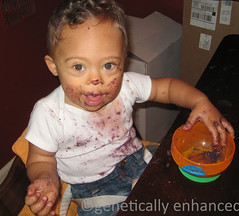
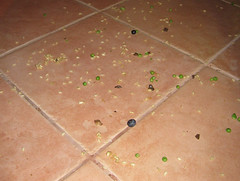
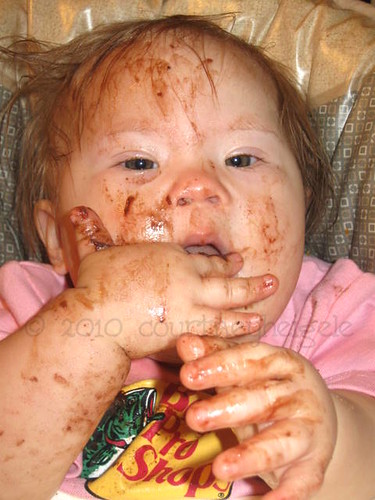
sheridanBabies are notoriously messy eaters. They figure out right away that throwing, squishing, and spitting food is fun. It takes a while to get good hand/eye coordination going and as they practice there are plenty of misses resulting in food in the eyebrows, hair, ears... you name it. thefloorThen there is the lack of solid motor-planning which means cups and utensils often end up on the floor. Picking an object up does not require the same skills as putting it back down, and for some reason learning to place items back on the tray does not seem high on a baby’s priority list.
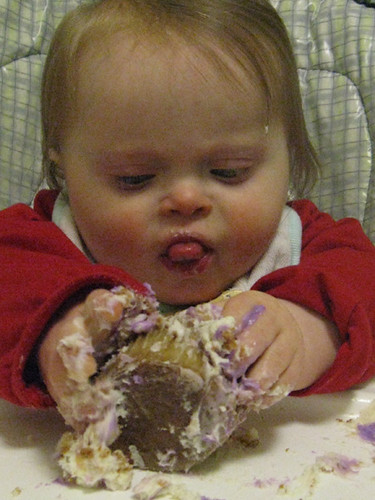
The first few times your baby ends up an absolute mess, it's kind of cute. You whip out the camera and preserve the memory for all time. Months upon months of glopped hair, soaked and stained shirts, and spills on the floor can become tedious. This same behavior in a restaurant or at a friend’s house could even be embarrassing. What’s a grown-up to do?

The Eating Arsenal
bib_mat

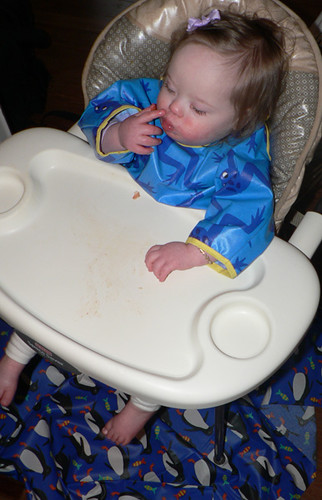
There’s no lack of bib styles out there, and after four kids I think I’ve tried them all. When I want to minimize the mess I go with the plastic full sleeve pocket bib that ties at the neck with a soft cotton collar bib underneath it for comfort as well as absorbing anything the dribbles down the neck. If your baby is not wearing short sleeves, roll up his sleeves before putting the bibs on.

Use simple hair clips to hold back your baby’s hair. You can do this for a boy too provided the macho police aren’t peeking in your windows during mealtime.

Position a spill mat under your baby’s highchair. We are using a Mimi the Sardine mat I picked up for half price on GreenBabyBargains.com. There are other brands that probably work just as well or even better.

mirrorWhenever possible (usually at lunchtime) I place a feeding mirror in front of Summer while she eats so that she can see herself eating. The speech therapist said this is supposed to help her visualize what she is doing. Make sure the mirror is out of reach, or that will end up on the floor too!

When I am planning on being right there the whole time, I use a place mat that we made for her that has a bowl/plate spot, utensil places, and a cup spot clearly marked on it. The mat does not adhere to the table so I have to be nearby to save the lunch bowl from ending up on the ceiling. The guides on the mat are to help her understand where to “set down” her eating tools. I only use this mat when I am specifically working with her on the concept of setting down her cup/utensils (instead of the usual Olympic shot-put method she has come to excel at.)

Keep a box of wipes or a damp cloth nearby so that you can wipe up spills as you go along. Keeping stray dribbles and chunks wiped up will keep them off the clothes, hair, and floor.

Consistent Caregiver Responses
After the first messy baby photo shoots, try to refrain from giving attention to messy eating. Don’t laugh or smile when your baby throws things, or blows raspberries with a mouth full of pureed peas. You don’t need to have a negative reaction either, a simple “No thank you, we don’t do that,” is fine.

Lessen Frustration by Teaching
Much of the mess is borne of frustration... baby wants more drink not more peaches and so the peaches go flying to the floor, etc. Teach your baby the signs for more and all done, and food and drink. Those words can make a big difference in how a meal goes. Your baby is going to let you know when she is done with her peas...she will spit the last ones out, or throw her spoon, or even swing her arms and knock the spoon out of your hands. If she knows the sign for all done, there is a good chance she’ll use it instead.

It is important for your baby to learn to wipe her mouth with a napkin or cloth. You want your baby to get used to this, to get in the habit of it. Children with Down syndrome often cannot feel little bits of food on their lips or cheeks/chin, and as they get older this could become a source of embarrassment or teasing. Teach your little one to always wipe her face after taking a couple bites of food.
quail_messAs mentioned before, setting items down requires different skills than picking items up. Teach your child how to release his grip on his spoon or cup and to place it back on his tray. Many times babies throw their utensils simply because they haven’t the motor-plan for any other method of releasing them. You can teach “set down” by using a hand-over-hand motion with your baby and gently tapping the spoon/cup onto his tray so he can hear and feel as well as see where it goes.

A Little Help from You
Spend a couple minutes doing some mouth prep prior to feeding your baby. Use your z-vibe (or let your baby chew on his vibrating teether) for a minute to wake up his mouth muscles.

When you are doing the feeding, place the spoon in the center of your baby’s mouth with a little pressure so that his tongue forms a “bowl” around the spoon, and then let him close his mouth on the food before you remove the spoon. Don’t scrape the food off the spoon against the inside of his upper mouth as you remove the spoon. If he is self-feeding, you can use hand-over-hand motions to guide the spoon or cup appropriately.

When your baby is drinking from a cup or eating something of thin consistency, you can help him to keep in that last sip by placing your finger under his chin and supporting his mouth closure with some slight pressure. This will encourage him to swallow that last sip rather than let it rush out.

This Too Shall Pass
pudge_mess

Learning to eat without a big mess is a process. Try not to get discouraged, and keep at it consistently... your little one will get there! One trick I use before each meal is to decide ahead of time how much mess I am willing to tolerate. From that decision stems my choices of how much to “bib up”, who gets to do the feeding, what she gets to eat, which cup we use, etc. For example if we are going out to eat, I make sure I have clips, a cover-all bib and neck bib, that I do the feeding and wiping, that she eats the least messy food on the menu, etc. If we are home and I am in a tolerant mood at lunchtime, she gets to practice self feeding with her own spoon and cup, and can eat a food that will stick to the utensil... I let her go at it on her own (and I even sneak pictures of her when she isn’t looking!)

Your Turn
Got a messy eater? Or maybe you have a feeding trick we need to know about? Tell us about it! Have you posted on this topic? Comment with the link and I will add it to the related posts.

Related Posts:
Homemade Monday: Feeding Kit


Picture Credits:
Sheridan from Genetically Enhanced
The Quail from The Tao of Tulips
Pudge from The Adventures of Pudge and Zippy

Monday, March 22, 2010

Pooey Looey

Warning: Ya’ll are going to think ds.mama is a bit nuts after this post. But I swear to you as crazy as it seems, it works. And successfully getting my 18 month old with Down syndrome ready to potty train is worth all your laughter and scorn :-)

Ah... potty training, a daunting task to accomplish with any child... Some people see potty training as an event, something you settle down and do one week. Not me... in our house potty training is a process that begins with elimination awareness and eventually ends two years or so later with saying bye bye to pull ups at bedtime.

During our last IFSP meeting, I mentioned that one of my goals over the next six months was to begin pre-potty training... Six shocked faces stared silently at me. Summer was 16 months old and her team was probably trying to figure out how to break it to me that she was nowhere near ready to start potty training.

Little did they know, I have been “pre-potty training” Summer since she was about six months old. I had learned some interesting things about potty training with my first few kids and I decided as each one came along to add to the “pre-potty training” repertoire all that I was noticing. I also had a friend who bravely did the EC method with her only child, and had relative success with it. I thought to myself, why not take the best of all this and see what happens.

Pre-potty training tricks
The very first step you can take, at any early age you choose, is to help your child connect elimination with a special sound. Notice how your infant child acts when he is poopin. There is likely going to be some grunting, wriggling, and a red face. Take the time to identify to your child what is happening. I sing a goofy made-up song to a warped version of the Sanford and Son theme song.... It goes something like, “A poo poo pooey, a pooey looey, a poo poo poo poo poo poo poo, a pooey looey...” Ahem, you get the idea (and yes, I do refrain in public).

If I have missed the event, I sing it when I am changing her diaper. The only time she hears this goofy song is when she is going or has gone poo. Over time, she has made the connection.

The next step is to help your baby associate going potty with a potty-chair in the bathroom. You can begin this step once your baby can sit on a chair or low bench on her own and can understand cause and effect and sequence. (An example of understanding sequence is that your child knows his routine and expects certain things to happen next. I usually start this step around 16-18 months old.)

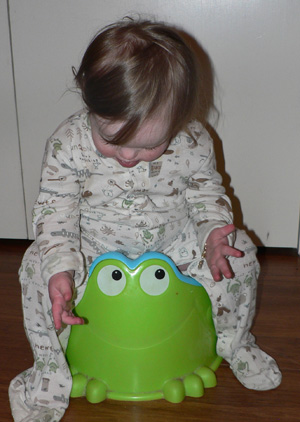
pottyFind a sturdy, comfy potty chair to keep in your bathroom. Make the sign for bathroom and then put her on the potty (clothes, diaper, and all) when she shows that she is getting busy. Sing the goofy poop song, and imitate her grunting. Yup, you read that right. Do some face to face grunting and then tell her it is her turn. She will imitate you back and you will be happily surprised at the results.
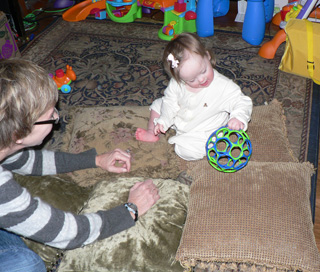
I do not start off doing this every day or for every elimination. When we have the time, and she seems very alert and is in a good mood, I will take her into the potty and let her practice. Sometimes if I am sure she hasn’t already started going, I will let her sit diaperless and actually go in the potty.

My pre-potty training goal is to teach her body to expect to go on the potty when she needs to poo. I have given her elimination awareness, a sign to use, and practice in the position. Next year, when she is ready to start actual potty training, she’ll already have these basics ingrained.

Your Turn
Ok moms who have been there, done that... do tell. How and when did you start potty training, and what worked best for your child?

From Theory to Practice :-)

Tausha: No Way!!! That did not just happen!!

Monday, March 8, 2010

EI—Who, What, When, and Why

The purpose of Early Intervention (EI) is to teach us how to give our little ones the extra support they may need to develop effective motor planning and skills.

pt1

EI starts off with the assignment of an EI service coordinator and an initial evaluation to figure out what therapeutical services will be beneficial for your child. During the evaluation you will be asked what things are important to you and your family concerning your child. Based on this evaluation and your input, a team of therapists is pulled together to help you and your child reach the goals you have set out.

The goals are written up for a six month period in a document called an Individualized Family Service Plan (IFSP). The IFSP is a living document that gets updated every six months (and sometimes sooner depending on any special circumstances) to reflect your families on-going needs and goals.

pt2

It is important to know three things about EI therapists... first of all, they work for you and your child, and you get to decide if the relationship is working out. If you are uncomfortable with a therapist for any reason at all, you can ask your EI service coordinator to switch the provider. Second, not all EI therapists have experience working with children with Down syndrome. And third, there are several concentrations within specific therapy fields. For example, some occupational therapists may have a strong background in sensory, while others may have more experience with self-care skills such as feeding and dressing.

When you are determining who will be working with your child, you should make sure the provider has experience with children with Down syndrome, and a level of expertise in the areas that are specific to your goals. In other words, not any old therapist will do.

pt3

Almost all infants with Down syndrome can benefit from working with a physical therapist (PT) and a speech and language pathologist (SLP) with a background in newborn feeding and oral motor skill development. Some infants may benefit from spending time with an occupational therapist (OT) who can provide a sensory program that includes deep pressure and brushing. Between 8 to 10 months of age, you probably should start pushing for a special instruction teacher. This educator will use play therapy to begin teaching your baby sign language, concepts such as in/out and up/down, as well as choice-making and other cognitive skills.

When EI is working right, you will find that you have a team of encouraging therapists who are:
—showing you at a detailed level all of the amazing developments your baby is achieving.
—training your child’s neurological pathways in effective motor activity and motor planning.
—teaching you how you can incorporate basic skill development into your baby’s everyday routines.
—teaching you how to provide your child with motor training, and sensory and cognitive experiences and that will help him develop constructive life skills.

pt4

EI is not about pushing your baby to the next big milestone, it is not about comparing your child to others, and it is not about making you feel inadequate as a parent. If you are experiencing those things, it may be time to consider some changes to your child’s team.

Your Turn
When did you start EI and what services did you start off with? What have been the pros and cons of EI for your family?

Wednesday, January 20, 2010

Communication 101

sam_teleParents look forward to hearing that first word... “dada” or perhaps “mama”. And when it comes, we are thrilled because we know that our child has connected words to objects, and that the rest of our spoken language is just a matter of time. But it is important to remember that speech is just one component of communication, and usually the last piece to be mastered.

The first communications between mom and baby begin at birth with cries, rooting, facial expressions, and eye contact (and maybe even before birth since we know that a newborn can recognize his mother's voice). While these first methods of communication come naturally, for babies with Down syndrome the presentation might be fainter or appear later than expected. For example, the smile is one of the first communication signals a baby gives us and it is important to realize that babies with Ds might smile later, less frequently, and less boldly than other children. The difference between a parent’s expectations and a baby’s skills can disrupt the mom’s ability to interpret her baby’s signals, making it harder for a harmonious relationship to develop.

What’s a Mom To Do
Like we do with all new love relationships, spend time studying your baby’s expressions and movements. Become sensitive to whatever communiques your baby is giving and respond to them accordingly with both words and gestures. It won’t be long before your baby figures out that he is the cause of these positive results. And so begins what we call “communicative intent”, using communication with the intention of affecting the environment.

Irene Johansson, author of “Language Development in Children with Special Needs”, suggests tactile intervention in the form of newborn massage several times a day. This provides the opportunity for the caregiver to communicate with the baby while the baby is experiencing a physical stimulation that heightens his awareness.

Requesting/Protesting
It is imperative to encourage a baby’s desire to communicate. The best way to do this is to be very responsive to him when he initiates any of the natural communiques of requesting and protesting. Don’t let him cry it out or make him wait if you can help it. Reward him with a smile, caress, or song whenever he is looking at you, kicking his feet or reaching out. Don’t worry about spoiling your baby by always giving quick and direct feedback. You cannot spoil a newborn with too much responsiveness or attention. And patience is a virtue that can be practiced after your child learns that communication is power.

Gazing
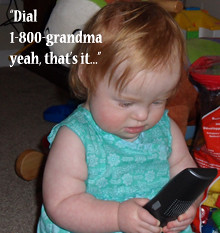
jmphoneBabies learn a lot about communicating by watching you do it. Research has shown that babies are predisposed to face watching. You can encourage your baby to look at you by keeping him close to eye-level in a carrier, or in a babyseat that is up on a table. If your baby doesn’t have the strength or coordination to watch you, hold her in a position that gives good support to her head and neck. While you are gazing at each other imitate any facial movements she makes, or stimulate her by making noises and expressions. Babies with Ds initiate less often, so take the lead and start a “conversation” whenever you get the chance.

Turn taking
Another important part of communicating is taking turns. You can work on this with your baby by pausing while speaking to him, as if you were listening to his response. You can also practice turn taking by shaking a rattle and then helping your baby to shake his rattle, back and forth several times. This builds the expectation of response, teaching your baby that communication results in response, or rather having your needs and wants met in some way.

Performative Communication
Performative communication is defined as the “speaker’s” deliberate, conscious, and goal-oriented use of communication (speech, signing, picture cards, body language, etc.)(Snyder 1978). Irene Johansson’s book is a week by week program for providing your baby with communication intervention that begins at birth. She makes a great case for why you would want to use her model (which incorporates massage, structured sounds, movement, and more) to help your baby develop strong communication skills.

I did not have this book when Summer was a newborn, and it wouldn’t have mattered because I do not have the discipline to follow such a structured program. However, that said, I have used some of the suggested program for the last year, and believe that for a caregiver who can do it, there would be worthwhile benefit.

Your Turn
Have you posted about a communication topic? Let me know and I will link to you.

To Love Endlessly: Communication
Face the Sunshine: Sign on...

Picture credit: Marissa from To Love Endlessly
John Michael from Monkey Musings

Monday, November 23, 2009

Peek-a-Boo, I See You

peekaboo

A while back it was thought that object permanence—the ability to understand that objects still exist after they are no longer in sight—was an intellectual all-or-nothing milestone. New research1 is showing that the concept of permanence is a process that begins with object identity, moves into understanding the transformational event in which it participates, and then ends with an understanding that objects themselves are permanent.

Huh? In English please...

What this really means is that babies don’t just one day “get it” that objects that have disappeared are still there. It is a long complicated process of understanding that begins around 3-5 months old (and perhaps even earlier) and continues until about 24 months old. Babies learn the concept of permanence in pieces. For example, a baby who is just beginning to understand permanence will look for a toy that has been covered by a towel by lifting the towel but this same baby will not do this if the toy was placed under the towel from a person’s hand. This is because the baby expects the toy to reappear where he last saw it, in the person’s hand. If he does not see it there, he will not yet think to look under the towel. In this case the baby thinks that the towel method makes things permanent but that the hand method does not. He does not yet understand that the property of permanence is inherent to the object not the method of disappearance.

Peek-a-boo games have always been one of the best ways to encourage an understanding of object permanence and given the recent new theories they still remain the best way to teach this concept. However, it makes sense to utilize several varieties of the peek-a-boo game to stimulate the various steps of understanding.

Peek-a-Boo Variations
If you use a particular tone and cadence when you play peek-a-boo variations, your baby will begin to anticipate that something is going to disappear/reappear. This will be helpful to your baby as the games get more complex.

1. Hands covering face or just eyes. This is the classic newborn peek-a-boo game that infants love. You can mix it up a little by asking baby while your face is covered, “Where’s (mommy, daddy, whoever)?” and then saying “Here I am” when you remove your hands, or by starting with “Peek-a” and ending with a rowdy “boo” when you uncover your face. You can also change your expression before and after you cover your face to stimulate your baby’s interest in the game.

2. Pop up person peek-a-boo... Use a hand towel or burp cloth to lift up in front of your face so that you “disappear” and then lower the cloth as you say “here I am” or “boo”. If your baby is not remaining focused on you when you play this variation, only lift the towel up over your nose so that your baby does not lose eye contact with you.

3. Peek-a-boo baby... Use a small scarf or burp cloth to gently cover your baby’s face (start by only draping the cloth over part of your baby’s face) and say, “Where’s (baby’s name)?” and then pull the cloth off and say, “There he is!” Soon your baby will pull the cloth off by himself and before you know it he may even initiate the game by pulling his bib or blankie up to his face.

4. Peek-a-boo books... Read books to your baby that have fold out pages or flaps. Use the flaps to play peek-a-boo by saying “Where’s (anything under the flap)?” and then “There it is” when you pop open the page. One of our favorite peek-a-boo books is Farm Peekaboo by DK Publishing.

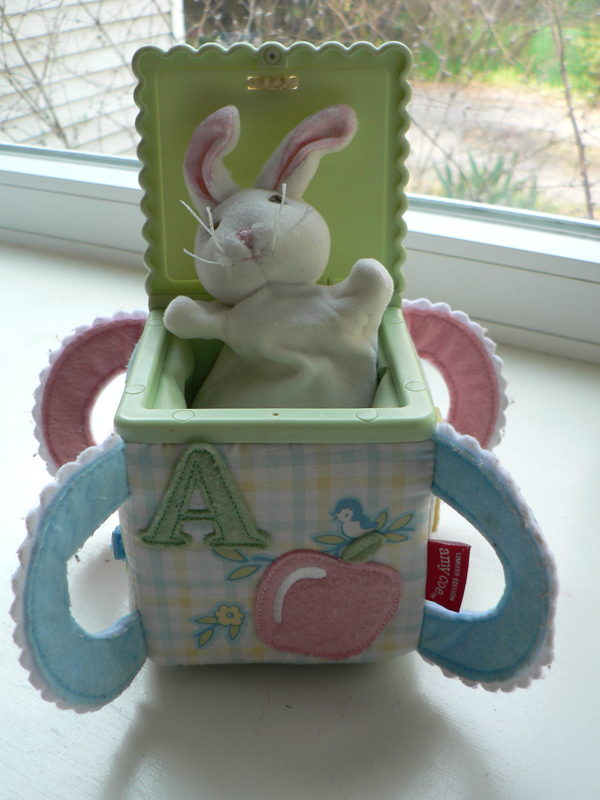
bunny5. Jack-in-the-box pop up toy... You probably shouldn't use a traditional jack-in-the-box musical toy for this game early on since the music takes a while and the “reappearance” requires the means-to-an-end motor skill of turning the knob. We have a hand-me-down pop up bunny that works perfect for playing a traditional peek-a-boo game using a pop up toy. At a later stage when your baby is able to sit and perform the fine motor skill of turning the knob, I would recommend the plastic musical jack-in-the-box available at beyondplay.com. It is very easy to manipulate the knob and does not require the fine motor skills that a traditional metal jack-in-the-box knob does.

6. Hidden toy peek-a-boo... place a small favorite toy on a highchair or swing tray, or the floor, in front of your baby. Cover it with a towel or other cloth and then ask your baby, “Where’s (the toy)?” Pull the cloth off the toy as you say “here it is” and then encourage your baby to remove the cloth by performing the action hand over hand with your baby. Keeping in mind what we now know about the early concepts of permanence, do not spice things up by placing a toy in your hand and then sliding in under the cloth or by switching the toy that is already under the cloth with a different toy.

7. Peek-a-boo picture of you... Print a 5x7 or larger photo of your face and affix it to a piece of cardboard. Raise the photo in front of your face so that you disappear behind it. Say to your baby, “Do you see (mommy, daddy, whoever)?” and then lower the picture while saying “Here’s (mommy, daddy, whoever)”. This game not only helps your child understand permanence but also helps him to understand transference between a picture of an object and the real thing.

8. Paper towel roll peek-a-boo... Take a paper towel roll and as your baby watches, stuff a small scarf or cloth into the end of it. As you ask your baby where the cloth is slowly pull it out of the other end of the roll. You can also use hand over hand to help your baby pull the cloth out of the roll himself. This is a more advanced peek-a-boo game because the object is not reappearing the same way it disappeared and so for a while your baby might think it is a different scarf coming out though it’s doubtful he’ll tell you that ;-)


(Research Credit: New Findings on object permanence: A developmental difference between two types of occlusion—M. Keith Moore and Andrew N. Meltzoff, University of Washington, USA)

Tuesday, November 3, 2009

The Stage One Oral Toolkit

In a way, speech therapy begins naturally for all babies on day one with eating, crying, yawning, rooting, burping... As those instinctual actions occur, a baby’s brain receives information and mouth muscle coordination beings. A baby’s brain also receives information about its mouth through stimulation, texture, and pressure (as well as taste... but stage one babies are usually getting only one yummy taste via bottle or breast.) Our babies need a little bit more information and more practice as the mouth masters its jobs.

Enter the oral toolkit, a treasure chest of goodies you can use to orally stimulate and train your baby. Most items can be purchased in a department store or baby store, some must be ordered online, and for those on a tight budget... your fingers are free :-)

The Nuk Brush


The Nuk brush is great for oral stimulation inside and outside of a baby’s mouth. On the outside, you can roll it down from just under your baby’s nose to her upper lip. You can do this same movement all the way around her mouth, rolling toward the mouth with each stroke. This stimulates lip closure. Used inside the mouth, the textures expose your baby to new sensations. Later on it can be used to introduce trace amounts of food to a beginning eater. $3.70

Red Cross Infant Oral Care Kit


This kit has a couple very useful tools in it. The finger infant toothbrush is used for gum tracing exercises and applying pressure to the lower jaw to encourage and strengthen the bite reflex. The gum stimulator is perfect for tongue walking and for gently pressing the center of the tongue to encourage your baby to make the bowl shape with her tongue. You can use the infant toothbrush on occasion in place of the Nuk to expose your baby to different textures. $7.99

The First Years Massaging Action Teether


The First Year's "Star" teether has different textures on each star tip. When baby puts pressure on a tip, the teether vibrates and wakes up the mouth muscles. This is also a great tool for demonstrating cause and effect. Though it is slightly big for a newborn, it can be used by a parent in small doses to stimulate the baby’s lips and cheeks. This teether is easier to trigger than other brands. 7.99

The Grabber


Easy to hold, your baby will love to mouth and bite on the Grabber teether thereby strengthening jaw muscles and control. It is a smooth teether and great for babies with who are showing signs of texture aversion. $6.50

Soothie Pacifier


A pacifier is good for letting your baby practice sucking and keeping his tongue down. I had some unused orthodontically correct pacifiers (my boys wouldn’t take them) and I tried to use them but was quickly corrected by our speech therapist who said the shape is not good for babies with Ds. Who knew? The hospital style Soothie is a good paci to use and luckily most hospitals will give you a handful on your way out the door but if not, you can get them online. Two for $4.79.

Your Finger
Nice clean fingers can be used to tongue tap, press the jaws to stimulate the bite reflex, rub the gums, gently pinch-pull the lips and cheeks, and trace lines on baby’s cheek skin. Your speech therapist, or a lactation consultant who has experience with children who have Ds, can show you many exercises you can use. You can also find detailed oral stimulation techniques in the books, Early Communication Skills for Children with Down Syndrome and The Down Syndrome Nutrition Handbook: A Guide to Promoting Healthy Lifestyles.

Z-Vibe


The Z-Vibe is a great tool for babies who have moved on to stage two but it is too powerful for newborns. I will do a post on this tool in the future.

Your Turn
Do you have a tip or trick you used for your baby's oral aerobics? Do you love/hate any of the tools in the toolkit? Share your thoughts with us.

Thursday, July 9, 2009

E plus I times X equals GUILT

Early Intervention therapists come to our homes weekly, bi-weekly, or even just monthly. They train our babies to develop their gross, fine, oral motor, and cognitive skills by conditioning their brains to learn movement patterns, sensations, and organization. They also teach us how to perform these specialized therapy activities and recommend that we do them on a consistent basis.

Daily... I am supposed to do oral motor stimulation prior to each meal and to fit in a 20 minute physical therapy session. I am also supposed to expose my child to classical music and signing throughout the day. Weekly... I am supposed to carry over what we do in pool therapy and to practice several activities suggested by a special education therapist and a teacher of the visually impaired.

I admit, I am already overwhelmed with multiple children, a job, a husband, a couple of blogs, a house to keep up, two moms groups, church... etc. And, some days, ok, maybe lots of days, I could easily not do any of the recommended EI activities. When this happens, guilt sets in and I envision my daughter never becoming independent because I didn’t find time to roll her around on a mat everyday. Oh, yes, I beat myself up for being an EI slacker mom.

Once the guilt takes hold, I start to wonder if EI even matters at all. Wouldn’t it be easier to just free myself of this cruddy feeling by axing EI altogether? What good is a bi-weekly 20-minute splish-splash in a pool anyway? Does it really make a difference if I stick my fingers in my daughter’s mouth for five minutes before lunch? Am I wasting our therapists’ time and our state’s money?

I confessed my shortcomings and fears to our physical therapist. She reiterated that, “It matters. Even if it is sporadic, it makes a difference.” Ok, so it’s worth it but how do we rid ourselves of the guilt and manage to get in more therapy?

Get Some Helpers
Enlist the help of siblings or other family members. A brother or sister as young as five can be taught to tickle a baby’s lips and cheeks with a Nuk brush. Siblings can learn beginning signs such as mom, dad, more, drink, etc. and can use them regularly with the baby. You can make a game of having all your children bombard the baby with specific sound combinations. For example today can be “ga gu, ga gu” day. (Grandparents, cousins, or any other family members work well too :-) And do not feel bad about involving other family members. You would think nothing of having one typical sibling help another with studying for a spelling test or practicing catch.

Call your local high schools to see if there are any responsible teenagers who would like to earn volunteer service by coming to your home once or twice a week to carry out therapy activities with your little one. Check with local colleges to see if there are students in an Early Childhood or Special Education programs who could benefit from the opportunity to volunteer in your home working with your child. You can show the student volunteer exactly what you would like them to do.

Make Routines
Devise ways to fit therapy into your everyday baby doings. Have your child’s therapists create some routine-based activities for you. For example, after each diaper change I have my daughter do two rotation sit-ups (a modified sit-up where she pushes up from her side into a sit position). When I dress her in the mornings and put her jamies on at night, I do a couple minutes of body massage. At lunchtime, I put her in the highchair a few minutes before her lunch is ready. While she waits, she chews on a vibrating teether or plays with her Nuk brush. By the time I get her lunch set up, most of her oral stim work is done already! This is formally called the routine-based early intervention model. Your therapists will know how to implement it into your individualized daily routine.

Have your child’s therapists write down a step by step therapy routine that you can follow for specific skills you are working on. Keep it short and simple. For example, have your PT write up a 15 minute warm up, skill practice, warm down activity list for you to use when you are working on a specific gross motor skill. Having a cue card to help you run through the moves will help you get it done.

Schedule in one or two therapy sessions a week on your calendar for you and your baby. Treating this like a weekly appointment may be what you need to make it happen. Completing a session with your baby even once a week will help you reach your baby’s EI goals and will leave you feeling like you have really accomplished something.

Ditch the Guilt
Feeling guilty about not carrying over early intervention therapies is a good sign that you care deeply about your child’s success and your role in it. So you didn’t do any therapy today... or yesterday. There is nothing you can change about that. Don’t go feeling bad. Remember that those days were filled with smiles, chattering, hugs and kisses, good food, and plenty of goings on for your baby’s edification. Tomorrow is a new day and who knows, you just might find yourself rolling your baby around your livingroom on a big plastic tube!

Guilt That’s Really Grief
I sometimes think that no matter what I do to help my daughter, I might still suffer a tinge of guilt wondering if there was something I missed. This feeling of guilt, brought about by skipping a day of therapy or even avoiding therapy, is really a “chronic sorrow” moment. Chronic sorrow is a normal ongoing part of the grief process. It is the occasional revisiting of grief when reminded that something has been lost. Catching myself slacking on therapy is a trigger that reminds me that life with my little girl is not typical. It is a reminder that things are tougher for her, a reminder that she has a disability. Once I realize this feeling for what it is, I give in to my boo-hoo moment, cry a few tears, and get back on track.

Your Turn
Have you got any ideas on how to integrate EI into everyday life? Got an EI slacker confession you want to make? Got some encouragement for us parents who aren’t sure what we’re doing is making a difference? Please take a minute and share it.

Friday, June 5, 2009

Picture Cards, Make Your Own

Language development... we’re all working toward it everyday with our children. We talk to them, sing to them, read to them, sign to them... But we know that reciprocation, our children being able to verbalize to us, comes later than their ability to understand language. So in the meantime we are teaching them other methods of communicating with us, using sign language and picture cards.

There are some good picture card resources out there. For free on the web, you can download and print cards from the See and Learn Language and Reading program. I like these cards because they use children with Down syndrome as models, the images are very realistic, and access to the cards is free. However, you still have printing costs, laminating costs, and the colors on the cards blend together too much, which I think might make object differentiation hard.

You could also purchase premade packs of First Word card sets. There are several packages to choose from, the colors are good but the sets are pricey and not all of the pictures in each set will be useful with every baby. Do I really care if my baby learns what a car key is?

To get the perfect set of picture cards for your baby, you have to make your own. It is easy to do and you will end up with a set of cards that is realistic, durable (chew-proof!), and specific to your baby’s world. When you make your own cards using your baby’s spoon, bottle, books, family members, etc., your baby can immediately recognize the object. Using cards from other sources means your baby has to be able to generalize that the picture of a cup is a representation of his cup. When your baby sees a picture of himself reading one of his books, it makes more sense than seeing a picture of just a random book cover.

All you need to get started is a camera, prints, and self-sealing lamination pouches.

Step 1. Take pictures of the objects your baby uses... his spoon and bowl, his bottle with milk in it, his cup, him reading his favorite book, you, his siblings, happy faces, sad faces, the family pet, toys, his crib... You can look at premade card sets to get ideas or jot down notes as you go through a couple days with your baby.

Step 2. Crop and print the pictures so that the object is the main thing in each picture.

Step 3. Laminate the pictures back to back so that each card has a front and back picture. Do not put pictures that could be offered as choices in the same pouch. You want your baby to be able to see both choices at the same time so that he can point to the card that has the object he wants.

Step 4. Show your baby the appropriate card prior to doing whatever is on the card. Before you know it, your baby will realize that the card represents the upcoming action or activity. Long before he can say he prefers an apple to a banana, he can choose the picture of an apple at snack time.

You can also use the cards when you are reading to help your child with generalization. When you get to a picture of a ball in the story, show your baby the picture of his ball. It is important that you also say and sign the word when you use pictures. Picture cards are a resource for enhancing language development and facilitating communication, not a total replacement for signing/speaking.

Your Turn
What picture cards are you using with you baby? Let me know and I will add a link here to your post about it.

Lori: Special Connection Homeschool: Introducing Reading with Sight Words
Perplexing Situation: Friday Organization

Sunday, May 17, 2009

Memory Development

Memory is the storage system for all information and new learning. Researchers have observed and suggested that the long-term memory function (skills learned and events recalled) for children with Down syndrome is good. Therefore we will focus on the short-term memory abilities and how to improve them.

The short-term memory can be compared to a computer CPU (central processing unit) that has two distinct hard drives, one for verbal/auditory information (called the phonological loop) and one for visual information (called the visuo-spatial scratchpad). More good news; the visuo-spatial short-term memory spans for our children is comparable to those of typically developing children of similar non-verbal mental age (mental age as determined through non-verbal skills).

However, verbal short-term memory spans, which play a critical role in learning to talk, are specifically impaired. There are several contributing factors to this phenomenon and studies continue to explore how and why these factors influence the phonological loop function.

The first thing to remember is that brain functions usually show dynamic development, meaning they are positively influenced by input and activity. Over time, with consistent intervention, a child with Down syndrome can improve his phonological loop function, thereby increasing his working memory function. This is important for many thinking skills but especially for the development of expressive language (speaking).

Keys to Increasing the Phonological Loop Functionality
After studying the factors that influence the development of the phonological loop, researchers have found several ways parents can help their babies, starting in infancy.

Good Hearing
It is imperative that your child be able to accurately hear words in order to differentiate between them. You can maintain good hearing ability by vigilantly protecting your child’s ears. Your baby should have a hearing test at birth, 3 months, 1 year old, and every year thereafter, and at any other time you think your baby is showing signs of hearing loss. Ear infections are the main contributor to hearing loss in children with Down syndrome.

To avoid ear infections as much as possible:


  • Do not nurse or bottle feed your baby when he is lying down, as the milk can flow into his ear canals from that position and cause infections.


  • Wash your hands, and make everybody else in the house do it too, often. Get some Purell, or another anti-bacterial hand sanitizer and use it prior to touching your baby. Clean your baby’s hands with Purell and then a baby wipe anytime he has been out in public touching stuff other people/children have touched. Be a germaphobe, it’s ok.


  • Do not expose your baby to any second hand smoke. This includes smoke residue on someone’s clothes, hands, face, and in their hair. Someone smoking outside and then coming in and holding your child is still second hand smoke exposure, according to the pediatric cardiologist that attended the babies in the PICU we were in. I heard him give the "talk" to many parents (he had a nose for cigarette smoke!)


  • Stay up on your baby’s vaccinations. Don’t let the controversy over some vaccines keep you from protecting your baby. You can ask for the flu shot that does not contain thiomersal (which has mercury in it) and you can hold off on the MMR until your baby is 2 or even 3 years old. (The MMR is the vaccine that has been questioned for its possible link to autism.) But do consider getting the pneumococcal conjugate vaccine and the influenza vaccine (the flu shot), since they protect against illnesses that are known to bring on ear infections. (Read the comments for this post to hear other parents' thoughts on vaccines.)

Instill a Love of Reading


Research has shown that children who are better readers show bigger gains in short-term memory ability. Daily reading instruction has a huge influence on the capacity of the phonological loop. In preparation for a preschool reading program, it is important for your child to be motivated by picture and story books. Reading picture books to your baby also provides visual support for learning language. Remember that your baby’s visual hard drive is one of his strengths and can be used to aid the development of the verbal hard drive. So go ahead and read to your infant for at least a few minutes everyday. Make it a special time that is comfortable and enjoyable.

Exposure to a Good Spoken Language Environment
Speak often and very clearly to your baby using child-directed speech. If you are not sure what to talk about with a newborn, you can describe what you are doing to her, or describe the things in her view. Do not use baby talk when speaking to your baby, as it is very important that she hear correctly spoken words from the beginning.

Also, try to include children’s songs that have sequencing in your repertoire of songs you sing to your baby (i.e. One, Two, Buckle My Shoe and There Was An Old Lady Who Swallowed a Fly) This helps to lay the groundwork for learning activities associated with phonological loop development that will become important in primary school.

This also means inclusion for your baby right from birth. If you have to make choices about your new baby’s environment (daycare or other programs) consider that a natural speaking environment is more stimulating and will provide more accurate language feedback for your baby than an environment where there are many children with delayed or impaired speech.

Play Babble Games
It is important to play babble games with your baby to encourage speech sound discrimination. Babble (i.e. ma, ma, ma or bla bla bla, etc.) to your baby and then give her a chance to babble back to you. Make sure you give your baby some extra time to reply since it often takes a baby with Down syndrome a little longer to process and organize responses. In the first months of her life you won’t get a babble response but starting as early as the 7th or 8th month, you will start to hear your baby babble back to you. (For us it was around 9 months old and only after she started eating puffs, which got her mouth moving in a new way.)

Evidence has shown that it is important to begin speech work in the first year of a baby’s life. There is a speech sound program, in book form, by Swedish speech and language therapist, Irene Johansson, that details how to provide specific ranges of speech sounds and combinations for your baby. The book follows a week to week format and is aimed at children with Down syndrome and/or autism. (If the expense of keeping up with all the latest books on Down syndrome is overwhelming, consider asking your local Down syndrome support group if they have a library and if they would include this book in it. Then go borrow it!)

Play Auditory Discrimination Games
To build on speech sound recognition you will want to move up to word recognition when your baby is ready. As soon as your baby is able to point and has comprehension for 50-100 words you can begin playing word discrimination games using pairs of picture cards or objects whose names rhyme or sound similar (i.e dog and frog, chair and bear.) You can ask your child "Which one is the chair, the dog, etc.? Then have your child point to the object.

Keep It Up
The activities I have mentioned are specific to improving your baby’s short-term memory function, attention span, and memory’s processing capacity. Research has found that these gains will not last over time if training and support for memory skills are not continued. Improving the short-term memory and all that comes along with it is a life-long endeavor, but the proven benefits are well worth the effort.

Straight From the Source
If you are interested in understanding the details of short-term memory or in reading the research I used (um, even somewhat plagiarized for your edification), you can read the publication Memory Development for Individuals with Down Syndrome by Sue Buckley and Gillian Bird online. The publication details strategies for increasing memory function for children up through the teenage years, so for those of you with toddlers and older children, it might be worth reading for the information I did not cover here.


Picture Credit
Lily from A Walk in Lily's Garden