Memory is the storage system for all information and new learning. Researchers have observed and suggested that the long-term memory function (skills learned and events recalled) for children with Down syndrome is good. Therefore we will focus on the short-term memory abilities and how to improve them.
The short-term memory can be compared to a computer CPU (central processing unit) that has two distinct hard drives, one for verbal/auditory information (called the phonological loop) and one for visual information (called the visuo-spatial scratchpad). More good news; the visuo-spatial short-term memory spans for our children is comparable to those of typically developing children of similar non-verbal mental age (mental age as determined through non-verbal skills).
However, verbal short-term memory spans, which play a critical role in learning to talk, are specifically impaired. There are several contributing factors to this phenomenon and studies continue to explore how and why these factors influence the phonological loop function.
The first thing to remember is that brain functions usually show dynamic development, meaning they are positively influenced by input and activity. Over time, with consistent intervention, a child with Down syndrome can improve his phonological loop function, thereby increasing his working memory function. This is important for many thinking skills but especially for the development of expressive language (speaking).
Keys to Increasing the Phonological Loop Functionality
After studying the factors that influence the development of the phonological loop, researchers have found several ways parents can help their babies, starting in infancy.
Good Hearing
It is imperative that your child be able to accurately hear words in order to differentiate between them. You can maintain good hearing ability by vigilantly protecting your child’s ears. Your baby should have a hearing test at birth, 3 months, 1 year old, and every year thereafter, and at any other time you think your baby is showing signs of hearing loss. Ear infections are the main contributor to hearing loss in children with Down syndrome.
To avoid ear infections as much as possible:
Do not nurse or bottle feed your baby when he is lying down, as the milk can flow into his ear canals from that position and cause infections.
Wash your hands, and make everybody else in the house do it too, often. Get some Purell, or another anti-bacterial hand sanitizer and use it prior to touching your baby. Clean your baby’s hands with Purell and then a baby wipe anytime he has been out in public touching stuff other people/children have touched. Be a germaphobe, it’s ok.
Do not expose your baby to any second hand smoke. This includes smoke residue on someone’s clothes, hands, face, and in their hair. Someone smoking outside and then coming in and holding your child is still second hand smoke exposure, according to the pediatric cardiologist that attended the babies in the PICU we were in. I heard him give the "talk" to many parents (he had a nose for cigarette smoke!)
Stay up on your baby’s vaccinations. Don’t let the controversy over some vaccines keep you from protecting your baby. You can ask for the flu shot that does not contain thiomersal (which has mercury in it) and you can hold off on the MMR until your baby is 2 or even 3 years old. (The MMR is the vaccine that has been questioned for its possible link to autism.) But do consider getting the pneumococcal conjugate vaccine and the influenza vaccine (the flu shot), since they protect against illnesses that are known to bring on ear infections. (Read the comments for this post to hear other parents' thoughts on vaccines.)
Instill a Love of Reading
Research has shown that children who are better readers show bigger gains in short-term memory ability. Daily reading instruction has a huge influence on the capacity of the phonological loop. In preparation for a preschool reading program, it is important for your child to be motivated by picture and story books. Reading picture books to your baby also provides visual support for learning language. Remember that your baby’s visual hard drive is one of his strengths and can be used to aid the development of the verbal hard drive. So go ahead and read to your infant for at least a few minutes everyday. Make it a special time that is comfortable and enjoyable.
Exposure to a Good Spoken Language EnvironmentSpeak often and very clearly to your baby using
child-directed speech. If you are not sure what to talk about with a newborn, you can describe what you are doing to her, or describe the things in her view. Do not use
baby talk when speaking to your baby, as it is very important that she hear correctly spoken words from the beginning.
Also, try to include children’s songs that have sequencing in your repertoire of songs you sing to your baby (i.e.
One, Two, Buckle My Shoe and
There Was An Old Lady Who Swallowed a Fly) This helps to lay the groundwork for learning activities associated with phonological loop development that will become important in primary school.
This also means inclusion for your baby right from birth. If you have to make choices about your new baby’s environment (daycare or other programs) consider that a natural speaking environment is more stimulating and will provide more accurate language feedback for your baby than an environment where there are many children with delayed or impaired speech.
Play Babble GamesIt is important to play babble games with your baby to encourage speech sound discrimination. Babble (i.e. ma, ma, ma or bla bla bla, etc.) to your baby and then give her a chance to babble back to you. Make sure you give your baby some extra time to reply since it often takes a baby with Down syndrome a little longer to process and organize responses. In the first months of her life you won’t get a babble response but starting as early as the 7th or 8th month, you will start to hear your baby babble back to you. (For us it was around 9 months old and only after she started eating puffs, which got her mouth moving in a new way.)
Evidence has shown that it is important to begin speech work in the first year of a baby’s life. There is a speech sound program, in book form, by Swedish speech and language therapist, Irene Johansson, that details how to provide specific ranges of speech sounds and combinations for your baby. The
book follows a week to week format and is aimed at children with Down syndrome and/or autism. (If the expense of keeping up with all the latest books on Down syndrome is overwhelming, consider asking your local Down syndrome support group if they have a library and if they would include this book in it. Then go borrow it!)
Play Auditory Discrimination GamesTo build on speech sound recognition you will want to move up to word recognition when your baby is ready. As soon as your baby is able to point and has comprehension for 50-100 words you can begin playing word discrimination games using pairs of picture cards or objects whose names rhyme or sound similar (i.e dog and frog, chair and bear.) You can ask your child "Which one is the chair, the dog, etc.? Then have your child point to the object.
Keep It UpThe activities I have mentioned are specific to improving your baby’s short-term memory function, attention span, and memory’s processing capacity. Research has found that these gains will not last over time if training and support for memory skills are not continued. Improving the short-term memory and all that comes along with it is a life-long endeavor, but the proven benefits are well worth the effort.
Straight From the SourceIf you are interested in understanding the details of short-term memory or in reading the research I used (um, even somewhat plagiarized for your edification), you can read the publication
Memory Development for Individuals with Down Syndrome by Sue Buckley and Gillian Bird online. The publication details strategies for increasing memory function for children up through the teenage years, so for those of you with toddlers and older children, it might be worth reading for the information I did not cover here.
Picture CreditLily from
A Walk in Lily's Garden

 Sound Shaker by Tickle Tap Apps 1.99 - touted as the 21st century rattle, Sound Shaker lets children create and play with chime, whistle, drum, barnyard animal and mystery sounds by simply tapping and tilting. Repeated taps generate new sounds, while longer taps grow sounds and trigger surprise animations. Tilting makes sounds spin and collide in whimsical combinations.
 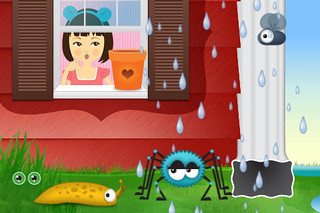 Itsy Bitsy Spider by Duck Duck Moose 1.99 - A musical book based on the popular song, with fully interactive, original illustrations. Follow the spider through the captivating, inter-connected scenes as he goes up the water spout, comes down with the rain, and watches the sun dry up all the rain.
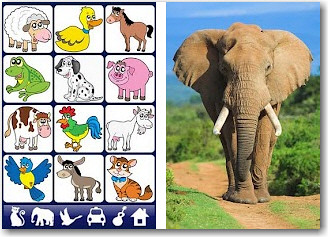 Sound Touch by Sound Touch 3.99 - Sound Touch has 6 categories, which are shown at the bottom of the screen as pictures – animals, wild animals, wild birds, vehicles, musical-instruments and household. Each page has 12 items displayed with bright, cute cartoon items. Tap a picture, and a real life photo of the item pops open, accompanied by the sound it makes. Tap the picture anywhere, and it disappears. There is a sound option in settings that makes it so that the app says the name of the item prior to making the sound.
 Peekaboo Barn By Night & Day Studios, Inc. 1.99 - This cute app features barnyard animals and the sounds they make. Babies can open the barn doors to find a new animal animation by touching the screen. They’ll learn about cause and effect and become familiar with animal names and sounds. As a bonus, you can record your own voice saying the animal name.
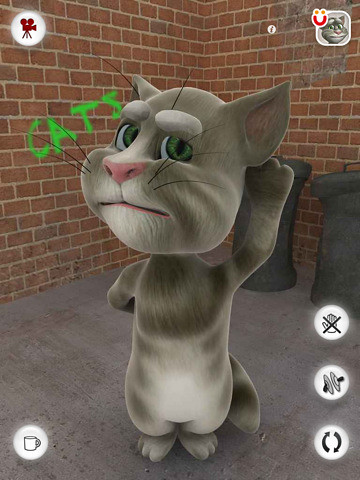 Talking Tom Cat By Out Fit 7 Ltd. Free- Baby’s first pet :-) Tom the cat responds to your touch and repeats everything you say or babble with a funny voice. When you pet him, he purrs.
 and a screen protector
 . You will be glad you did.